
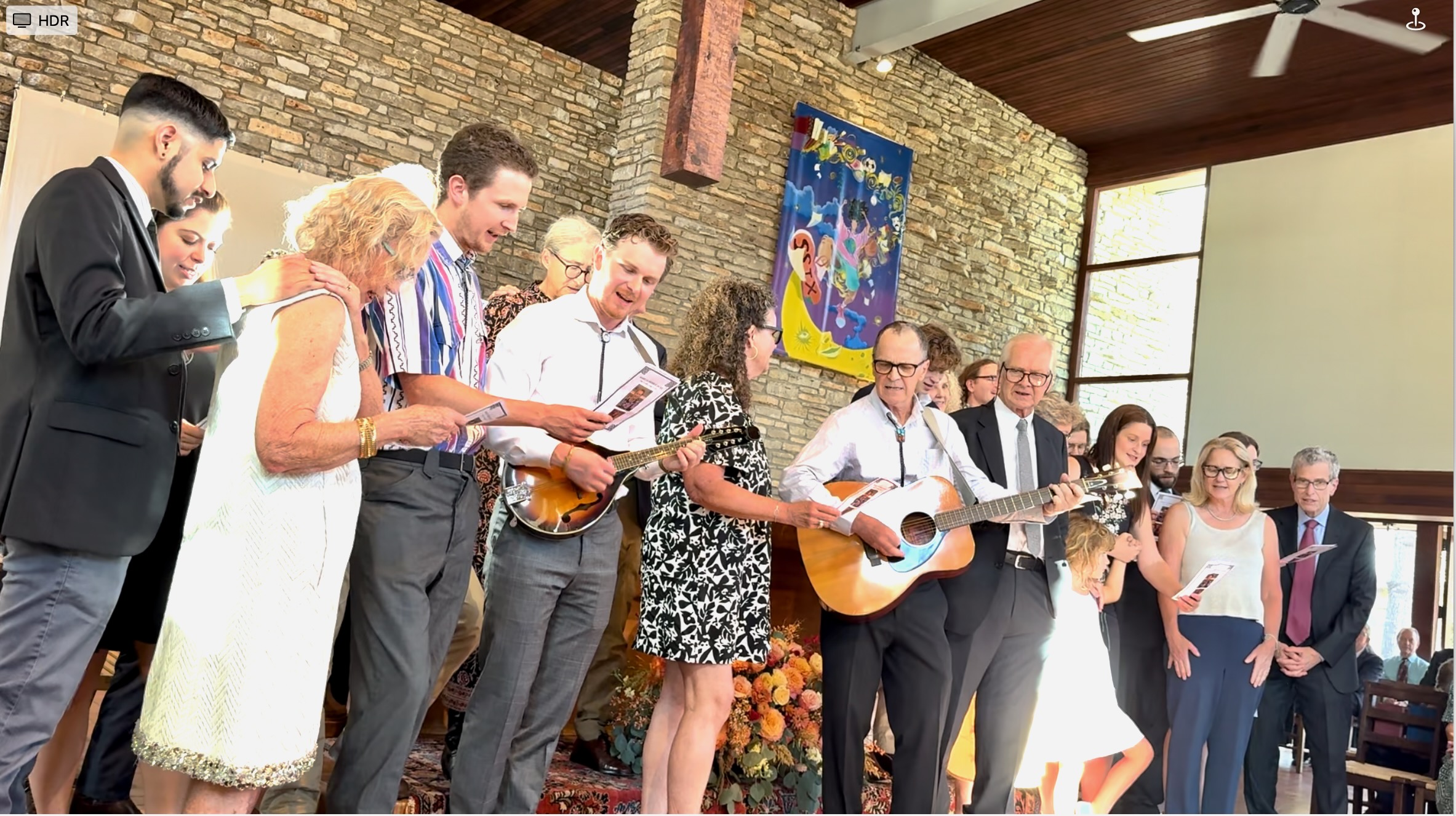
Yesterday we gathered in Austin for the memorial for my aunt Marilyn Dickie, on a warm day in a light-filled chapel with friends, most of them generations younger than our 95-five-year-old matriarch of seven children, all of them present, all speaking to an aspect of her life. The theme was how lucky she thought she was, and how lucky we were to be in her orbit.
Marilyn babysat my dad, four years younger, when their parents were friends in Denton. A refined woman of gracious Southern manners, she had married a cowboy, my uncle Alec, and moved to Washington, Alec to work for Senator Ralph Yarborough, the liberal bête noire to Lyndon Johnson, who in his congressional career built a personal fortune from the bidniz of Texas. When my dad finished law school in Austin in 1962, he was drawn to the Capitol by John F. Kennedy’s call: “Ask not what your country can do for you, ask what you can do for your country.” With Alec in the room, the senator hired my dad. Marilyn and my mother, also a refined woman of gracious Southern manners, became best friends for the next four decades, until my mom died, in Austin, 20 years ago next month.
I have a bunch of cousins, all of them then and now in Texas. The Dickie clan didn’t feel like cousins but more like siblings, especially child five, Joe (here leading “Keep on the Sunny Side” on guitar). In my experience, cousins live 1500 miles away. The Dickies lived a short drive across Arlington.
I wasn’t one of Aunt Marilyn’s godchildren, as the Dickies became extended family when I was 4. Six years later we—the Mintons, Yarboroughs and others—used multiple cars to ferry them and their luggage to the airport. Alec, by then with USAID, was going to Nairobi just before Nixon was inaugurated. (It was one of their several foreign stints in serving Kennedy’s second line: “Ask not what America can do for you, but what together we will do for the freedom of man.”) When they returned four years later, I spent weekends on their farm outside Berryville. Before and after their excursion, I rode Uncle Alec’s horses over hill and dale along the Shenandoah, an experience that in my 40s led me to buy into a similar gentleman’s farm on the east side of the front range, in Sperryville.
Marilyn was “best man” when my dad married Phyllis in 1980, a wedding with seven witnesses, including me. In 1995 I named my second child after her. In 2012, eulogizing my Dad through wails of tears, Aunt Marilyn put her hand on my back. I returned to Austin for Uncle Alec’s memorial service six years ago, and took Phyllis to Austin in January just to be in her presence.
I last spoke to her shortly after her birthday, in June. I told her what I was up to—going to the Tour de France—and she told me, again, how proud she was of me, how much she loved me, how much she missed my mom.
I am lucky because—well, that’s obvious. I was born into a family endowed with education and support. My mother’s father put Dad through law school. In our post-war bloom, a (white) man could go to work for our government and his modest salary could support a family and a mortgage and a car and vacations and never miss a meal. And now that I’m a senior citizen, I benefit from a Congress that virtually guarantees that people with my background and education and acumen can go to the Tour de France on a lark.
I just spent a week on five airplanes, visiting a dear friend in Tulsa, and then Phyllis in Denton. We had meals out and toured museums, and in Fort Worth we splurged on a downtown hotel. We picked up my sister, who’d flown in from SoCal, and drove to Austin, where my stepdad hosted us in the house where my mom died. Then we gathered with these mutual witnesses of six decades. All of it went off without a hitch, and I arrived home at midnight. I am grateful.
The TSA agents and air traffic controllers had gone without pay for a month because the president and congressional majority are guided not by “ask not” but by what-can-I-get. And in every city of any size including Portland, Tulsa, Denton, Dallas, Fort Worth and Austin, people are lined up at food pantries, not just because their president appealed to the Supreme Court to cut off SNAP but because this is the country we’ve created, and this is the government we’ve elected.
The Dallas Holocaust and Human Rights Museum, which we toured six days ago, frames a chronological narrative of the rise of the Nazis, who used language no different than the man riding down the golden escalator. In the decade since, “Young Republicans” are caught on social media praising Hitler, and podcasting demagogues in the mold of Father Caughlin provoke outrage and yawns. This is how it started.
I am so furious that tomorrow Laurie and I will fly to Portugal. We are investigating whether and where we might expatriate. There’s an irony: Portugal was ruled by a fascist dictator for 40 years. The Salazar regime’s program was much like the current occupant’s: a corrupt elite ruling a country illiterate and detached, without adequate schools, hospitals or engines of prosperity. After the 1974 bloodless coup, the military staged free elections, drawing candidates from Stalinists to fascists. Amid the Cold War, the U.S. having excused the government’s horrendous human rights record to ensure Salazar would remain in the Western fold, Henry Kissenger assumed the people would fall into the Soviet orbit. But the voters chose left-of-center social democrats in the mold of post-war Western Europe. The Portuguese are still recovering from lost decades, but they love the EU, and they are very tolerant. Tolerant, period. My quip about our exploration is that I’m interested in a country that has known fascism and rejected it, rather than one that is sinking into it.
I doubt we’ll make the leap, but I want to be prepared. After seven years in Portland, I feel attached to my community and fascinated by the western half of my homeland, studying five centuries of European conquest and colonization west of the 100th meridian. And as my Dickie sibs said, my family is here. I don’t want to leave. Maybe we’ll wake up. With or without blood.
 Transformational Citizenship