
I am traveling the country for two months, but politics is never far from my mind. See my other site, generally devoted to thoughts about bicycling, but in this case travels without Charlie: Temporary border in the Big Ben
I am traveling the country for two months, but politics is never far from my mind. See my other site, generally devoted to thoughts about bicycling, but in this case travels without Charlie: Temporary border in the Big Ben
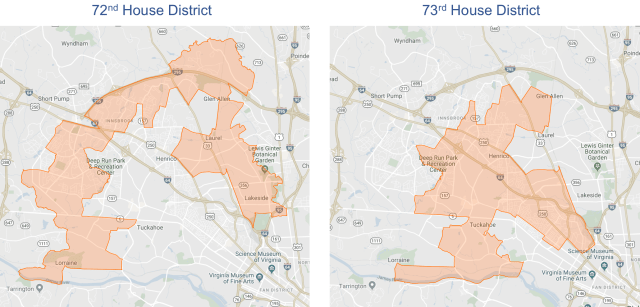
Maps derived from Virginia Public Access Project
Gerrymandering has broken through the din of partisan grenade-throwing to become a top-tier issue of voter concern across the political spectrum. If we cannot fix this party- and incumbent-protection racket, We the People are coming to understand, we will cease to be a representative democracy in which one person/one vote has any meaning.
This term the U.S. Supreme Court is hearing political gerrymandering cases from Wisconsin, Maryland and North Carolina, and one involving Texas’ indefatigable effort to suppress the franchise. This week it received a second appeal from Pennsylvania Republicans of their state’s supreme court rejection of one of the most distorted U.S. House maps in the nation.
Meanwhile, the Virginia Supreme Court is about to decide a narrower question: whether the 2011 maps for the House of Delegates (drawn by Republicans) and Senate (drawn by Democrats) were so gerrymandered as to fail the state constitution’s requirement that districts be compact.
The court heard 40 minutes of oral argument in Vesilind v. Virginia State Board of Elections on March 1, nearly a year after a state district court in Richmond decided against the plaintiffs in 11 districts – five House, six Senate – and for the defendants, who in the case of the House plan had been joined by the House of Delegates and its speaker as intervenors.
“When a statute’s constitutionality depends on fact, the legislature’s factual determination will be set aside if it is clearly erroneous, arbitrary or wholly unwarranted,” wrote Circuit Judge W. Reilly Marchant. Relying on 1992 and 2002 Supreme Court precedents, he wrote that “if the evidence offered in support of those facts would lead reasonable, objective persons to reach different conclusions, then the legislative determination is ‘fairly debatable’ and must be upheld.” Marchant found the constitutional validity of the 2011 maps “fairly debatable.”
On appeal before the Supreme Court, the Vesilind plaintiffs contended that the trial court had erred by failing to shift to the legislature the burden to produce evidence of reasonableness. In fact, wrote A.E. Dick Howard, a University of Virginia law professor who was principal drafter of the current state constitution, the General Assembly submitted no evidence at all. (Judge Marchant had found the Senate in civil contempt for its failure to provide documents in discovery, a finding the Supreme Court vacated on grounds of legislative privilege.)
Howard, who with three other law professors submitted an amicus brief, wrote: “[T]he circuit court did not require the Legislature to identify any standard guiding line-drawing decisions to ensure compliance with the constitutional compactness command before declaring the issue to be ‘fairly debatable.’ The circuit court’s failure to do so permits the Legislature to claim that it satisfied the constitutional requirements without having to demonstrate that it made any bona fide attempt to do so.” [Italics in original.]
In the appellants’ brief, Wyatt B. Durrette, Jr., wrote: “The evidence before the trial court established that the Legislature subordinated the required criterion of compactness to discretionary criteria in violation of the Virginia Constitution. Without correction, the trial court’s erroneous decision allows the Legislature to continue undermining representative democracy and the Virginia Constitution.”
To the layman, the 11 districts, which include the 72nd House (a.k.a. the “toilet bowl”) but not the 73rd, are laughably not compact. The legal question turns on: how compact is compact enough?
For that legislatures and courts (as may be required) turn to Ph.D.s in legislative map-making, who have devised formulas to express deviations from a mathematically pure ideal: the circle. And courts, for their part, grow uncomfortable at the prospect of overturning legislative prerogative.
In the Vesilind trial, both sides presented learned map analysts to walk the court through mathematical tests that go by the names Reock, Polsby-Popper and Schwartzberg, all of which are used to arrive at a deviation from perfection. Said Vesilind, the 2011 maps fail the tests. Said the legislature, no they don’t. Said Judge Marchant, it’s debatable.
Said Chief Justice Donald W. Lemons at the Supreme Court, “Thank you.” There were no questions from the seven justices.
After the argument, Durrette held a briefing before plaintiffs, amicus lawyers and other supporters of OneVirginia2021, the Richmond nonprofit that is leading the state’s grassroots-based, nonpartisan charge against political gerrymandering (and my favorite charity).
Durrette, an eminent figure in the Virginia bar who served three House terms and ran unsuccessfully for attorney general and governor as a Republican, suggested that the high court’s decision will turn on whether to accept the math of the plaintiff’s expert witness, Michael McDonald, whose testimony the defense tried and failed to exclude at trial. McDonald had testified that the “degradation of compactness from ideal” could not be attributed to “required” criteria – the supreme mandates of federal law (equal population and Voting Rights Act compliance) or the state constitution’s “contiguous and compact.” Rather, the maps elevated certain “discretionary” criteria – such as economic, social, cultural, geographic, governmental jurisdictions, and – bingo – political beliefs, voting trends and incumbency.
Alternatively, Durrette said, the court could accept the legislature’s argument: it met the standards of compactness the Supreme Court upheld in Jamerson v. Womack and Wilkins v. West, which grew out of the legislature’s 1991 and 2001 maps. Even so, Durrette said during oral argument, those precedents do not apply in Vesilind. The earlier cases involved compactness standards in the context of Voting Rights Act requirements, which in the Vesilind districts are not applicable.
The Voting Rights Act is at the heart of a separate case involving 11 other House of Delegates districts. In Bethune-Hill v. Virginia State Board of Elections, the plaintiffs unsuccessfully argued before a federal district court in Richmond that the House had unconstitutionally “packed” minority voters into those districts by using a “floor” of 55-percent BVAP (black voting age population), thus diluting their representation across a wider number of districts. But on appeal, the U.S. Supreme Court ruled that the three-judge panel had used the wrong standard. (It reduced the districts at issue from the original 12 to 11.) On remand, the parties completed post-trial briefs in December, and the district court’s decision is pending.
In both cases, plaintiffs have asked the courts to toss the maps and call elections. At stake are not only the districts under review but of course those that are contiguous – that other word in the constitution’s map-drawing mandate.

Government troops fire on Shays’ Rebellion (cite unknown)
I keep seeing these fairy tales about the origins of the Second Amendment — that its purpose was to guard against the tyranny of the government by enshrining an individual’s right to own a gun.
The Constitution was ratified in reaction to the weakness of the Articles of Confederation. A bunch of ragtag former colonies had somehow managed to wear down the British over five years under a skeletal cooperation agreement, during which the Continental Congress spent much of its time pleading for money from the 13 former colonies.
Then critics managed to convince the states to appoint delegates to a constitutional convention separate from the state legislatures, which were jealous of their sovereignty. They met in secret and came up with a plan that barely achieved ratification. Thus the United States was born.
Virginia and New York were the last of the 11 states that with varying reservations put the Constitution into effect (it required nine but practically could not have succeeded without those two), and Rhode Island and North Carolina were still recalcitrant. So during the First Congress, while Hamilton was constructing the executive branch and Madison was pushing legislation through the House to create a government from scratch, Madison also convinced Congress to take up the Bill of Rights (originally 12 amendments but finally 10).
The First and Fourth through Eighth are a logical piece of poetry about the rights of individuals. The Ninth and Tenth are about the relationship between the states and the federal government. The Second and Third dealt with problems that had confronted the colonies/states.
The Third, which we never talk about anymore, prevented the government from housing soldiers in your home — a cause of the revolution. It’s the forgotten amendment.
The Second was forgotten for more than 150 years. Its purpose was to ensure that the federal government, which barely functioned and was in debt (to Americans, British merchants, the French, etc.), had access to a standing army to confront enemies foreign and domestic. And there were both.
The British, still pissed about their humiliating defeat, continued to foment trouble on the western frontier. Domestically, throughout the post-war period, the states and their people were angry about paying taxes (some things never change).
In 1786-87, Daniel Shays led a band of rebels against the government of Massachusetts over taxes. Shays’ Rebellion drove General Washington out of retirement. The Constitutional Convention followed shortly.
So the Second, in a period while Congress hadn’t even gotten to the argument about whether to have an army, was intended to create an alternative: “A well regulated Militia, being necessary to the security of a free State, the right of the people to keep and bear Arms, shall not be infringed.” The idea was that the states could be called upon to support the feds. It was not so that people would have the right to prosecute an insurrection against the government that THESE LEADERS HAD JUST CREATED.
After The Federalists were dispatched in 1800, Jefferson came to see that a standing army and navy was a good idea, handy for fighting on the shores of Tripoli. His successors found them useful for battling Britain and soon enough Indians. State militias were the backbone of the Civil War.
We went along that way, thinking no more of the Second than of the Third until the 1970s when, after an internal battle at the NRA that coincided with a period of domestic unrest and the truncated reign of a “law and order” president with paranoid tendencies, an argument was conceived that the amendment was about protecting your right to own a gun. That hadn’t been an issue for 350 years in a country whose expansion was forged at the barrel of a gun, individually and collectively.
And now we have a Gun Manufacturers Association whose purpose is to sell guns by stoking fear of your fellow countrymen. Next up: arm teachers. Because the only way to stop a bad man with a gun is to have a good man with a gun.
Tell that to Ronald Reagan’s Secret Service detail.
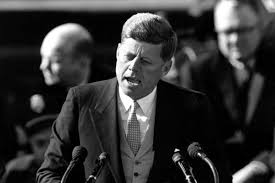 Fifty-five years ago this week, I woke up in Arlington for the first time, a four-year-old transplanted from Texas. Upon finishing law school in Austin, my dad had answered Kennedy’s call, “Ask what you can do for your country,” and gone to work for his senator, Ralph Yarborough.
Dad became an expert in his area — the postal service, one of the enumerated powers of Congress, its purpose to knit together a far-flung republic.
The centrifugal forces that have often confronted this union seem especially strong. I know my dad would not have been inspired by this president, whose only consistency seems to be in appealing to the emotions that divide us, as his administration goes about piling comforts on the comfortable and afflictions on the afflicted. Dad, on the other hand, was proudest of the legislative projects that made things a little easier for constituents of neither means nor power.
Kennedy’s inaugural rejoinder was: “My fellow citizens of the world: ask not what America will do for you, but what together we can do for the freedom of man.” I do not hear in Kennedy’s current successor any thought of those under other flags, except as foils he uses to inflame us.
I remain depressed after the carnage in Las Vegas. As FBI agents search for a rationale, I feel certain they will not find one. Nor will they issue a statement that puts mass murder in context: This is a manifestation of a country that says, I need protection from Other. But there is no protection, nor is there Other. There is only Us, and we’re too afraid to see that.
I’d be wrong to assume Dad would no longer recognize this country, as he was a student of American history. He’s probably wearing that sardonic smile, mulling the folly of man, and optimistic that things will, some day, get better. Which is why we get up in the morning and work for it in our own ways, large and small.

John McCain’s thumb-down; Mitch McConnell’s crossed arms
As societies become more complex, the government (the instrument of our social compact) is called on to do more to arrange commerce – the exchange of goods and services. Market regulation is a necessary component of development, to ensure some transparency for all participants in an otherwise free market.
We regulate commerce to mitigate risk. The FDA weighs the safety and effectiveness of a pharmaceutical against the risk of not taking it. The Department of Transportation regulates every vehicle – cars, trucks, airplanes, trains – to protect the public from the market power of sellers and operators. The EPA regulates the quality of air and water, balancing the risk to people against private activity.
Insurance – a mechanism for the mitigation of risk – is available in nearly every sector of society, all policies in essence reducing personal liability. And every insurer is regulated, to ensure that the issuer can actually pay a claim.
Yet for decades America has been fighting over the provision of insurance for our most vital and personal concerns – having our health problems addressed without going bankrupt – and somehow this market gets caught up in ideology over “free markets.” There are no free markets (except the black market). Health insurance and medical care exist in a regulated free market. Only the VA has government-managed health care.
In the debate over the Affordable Care Act, at stake is whether all citizens can participate in the health insurance market at a price they can afford. The question invokes John Rawls’s “veil of ignorance”: What sort of system would you create if you had no idea where you would fit in it – whether you had money or not, whether you had health or not? Rational people choose a system that allows everyone to participate (rather than adding risk to being born poor and unhealthy). We recognize our self-interest and our moral (or perhaps ultimately selfish) interest in not having to watch people die on the street.
Suppose you are in charge of a hospital’s admissions. A little boy shows up in the ER bleeding from a severed arm. He has no insurance and no money. He’s not even an American citizen. He will die if you don’t admit him. What do you do? As a society we’ve decided: admit him.
Then the question is, who pays for it? The answer, consistent with our social compact and the financing principles of Medicare and Medicaid, is that the healthy and the economically better-off pay more. The ACA, like intermediate programs enacted over the past 30 years (coverage for poor children, the prescription drug benefit), is an attempt to include more people in a risk-sharing market.
For decades the Republican Party has opposed any system that would allocate health care by any means other than one’s personal ability to pay. The GOP opposed Medicare (the most effective poverty-reduction program ever), though 40 years later, in 2003, it sponsored the prescription-drug benefit. For seven years, it has fought to destroy Obamacare by every means available.
Today the party’s effort apparently came to a humiliating end by a single vote on the Senate floor, at 1:30 a.m. After failed attempts to repeal taxes on the wealthiest 5 percent of households by slashing Medicaid, Majority Leader Mitch McConnell’s final proposal was a bill to pull the legs out of the system, by ending the requirement that employers offer insurance and employees have it. That would have led to the collapse of the individual market, which before Obamacare functioned arbitrarily to suit the need of insurance companies seeking to mitigate their own risks.
With passage, millions of Americans might have risen up against the party, which in all its time in opposition never considered either a replacement or addressed comprehensively the critical question: Who pays for the care for the little boy who arrives at the ER?
It will turn out to be a blessing, provided the party inquires into what ails and acts to fix our dysfunctional health care system, which costs twice as much with less benefit than that of any other industrialized country. Candidate Trump promised better insurance at lower cost. Whether his party will take up that promise remains to be seen.

The High Line in Chelsea, Manhattan’s reclaimed park
Last week I attended commencement exercises at a prestigious university in the nation’s most diverse and creative city. The standard of living between rich and poor is nowhere greater than in New York, and the opportunities for graduates of Columbia University could place them among the most affluent people ever on the planet (if that’s the path they choose). I sat among the next generation of the elite, not only from the United States but all over the world.
In the commencement address he reserved for himself, President Lee Bollinger advocated for everything his university represents: inquiry, discovery, reason, collegiality, inclusion – not for their own sake but in order “to understand and engage our modern, inter-connected world.” Columbia, because of its history, location and mission, Bollinger said, “has embraced the responsibility to be an American university with an international scope . . . We are properly proud of our international students and faculty, and of our research and educational work all over the globe. The free movement of people is vital to this intellectual work.” The purpose, he emphasized, is to improve the common good and address pressing challenges. Among them he cited climate change, food insecurity, global migration, and the potential for medical innovation.
And yet, I thought, this august institution is the sort mistrusted by the 40 percent of voters who make up the base of our ruling political party. The Columbia community is winning the worldwide game. At the separate commencement for the School of Engineering, I spotted handfuls of “white kids”; the vast majority of graduates appeared to be from China, India and elsewhere. Columbia draws the brilliant from the world – and unless we get our immigration policy straightened out, many will continue to go home and help their countries rise rather than stay here to help ours. Either way, they will aid the progress of our one planet.
The ruling base doesn’t seem to care about that. As David Rothkopf, who among other occupations teaches at Columbia, recently wrote in Foreign Policy, “To many of [President Trump’s base], knowledge is not a useful tool but a cunning barrier elites have created to keep power from the average man and woman.”
Well, that base has a point. The creative geniuses who travel through Columbia, one may suppose in an us-and-them view, have done relatively little for Middle America. Maybe they’re more likely to journey down to Wall Street to play arbitrage with other people’s money, or make some other contribution that benefits those who live and work in the blue cities. And the blue cities, I observe, are doing quite well.
Over the four days of my visit that I wasn’t hanging with my graduating daughter, I was exploring the island that was my home in the early 1980s, a grim period in New York history. Back then I would not have dreamed of walking at 10 p.m. the two miles from Columbia to Harlem, where I was staying with a friend. Times Square reeked of insecurity if not danger, any time of day. The city was only a few years from near-bankruptcy, its avenues crumbling and subways covered in graffiti, and the emblematic news story was a white “subway vigilante,” Bernard Goetz, who wounded four black men with five bullets, yet was found guilty of a single unlicensed-weapon charge. I could relate.
But as a journalist covering the nexus of business and government, I reported then on the infrastructure plans that were afoot, as city leaders envisioned some of what has come to pass – cleaned-up subways, huge new developments on both sides of the Hudson, expanded parks, invisible waterworks. New York has historically low crime rates and a growing population thanks to net international migration. The ubiquitous hot dog carts have converted their fare to Middle Eastern lamb/chicken-on-pita. And everywhere: bike lanes. I’m delighted my daughter is staying in the city.
How to bridge the fortunes of our prosperous, service-oriented cities and hollowed-out manufacturing and rural areas is said to be tops on the nation’s economic agenda. Yet our leaders have no program for that. If Congress weren’t distracted by the president’s self-inflicted crises, it would be slashing Medicaid and cutting taxes while blaming the stagnating fortunes of the working class on foreigners. Meanwhile, my daughter faces a student loan debt to be repaid at 6.5 percent, a source of government profit set by Congress.
Until our reigning party quits demonizing that which is foreign – a regular boogeyman in times of fear and scarcity – and focuses on developing a worldwide integrated economy of capital and labor flows to match our potential, we will be stuck between yesterday and tomorrow. But my daughter, I expect, will do just fine.
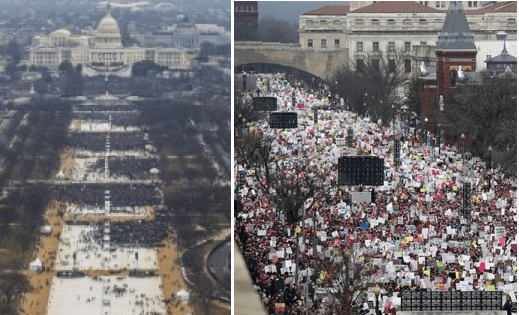
The National Mall, January 20 (left); Independence Avenue, January 21
Any list of President Trump’s accomplishments will reflect the biases of its creator.
Justice/Immigration/Civil Rights
Economy/Labor/Finance
Environment/Energy
Health care
Education
Gun violence prevention
Government Transparency/Russia
Civic Engagement
The Trump presidency has aroused people across the political spectrum to engage in a way not seen in generations. Politics does matter. Our renewed awareness is his greatest achievement.

In the glory days, with Bob Dole
Newt Gingrich lives in President Trump’s first pass at a federal budget.
The purpose of a budget – government, corporate or household – is to put vision in numbers. First identify the goals, the strategies to execute them and their projected costs, then set income to a level required to act on whatever priorities are realistic.
When Gingrich became House speaker in 1995, he inverted the formula. Said the speaker, the budget is first a number, then strategies to meet whatever goals can be addressed within that number. He argued that families and businesses operated the same way – apportioning fixed income to needs and desires.
Noble as that may sound, that’s not how households or businesses operate. Families borrow – mortgages, car loans, credit cards – to fulfill a vision. Corporations meet a plan by borrowing from banks, selling stock and issuing bonds.
This week Trump followed Gingrich’s notion in releasing a 53-page outline of the one-fourth of federal spending devoted to discretionary spending: The first principle is the number. The president said he would increase defense spending $54 billion and cut non-defense discretionary spending by the same amount, maintaining a total discretionary budget of $1.065 trillion. (Discretionary is the part of the budget that Congress sets each year covering the goods and services government buys; mandatory, which constitutes nearly two-thirds of the current $3.9 trillion budget, is transfer payments based on criteria: Social Security, Medicare, federal pensions, other income-security programs.)
Perhaps sometime later the administration will outline a vision, but so far Trump’s has only a slogan, to make us great again. How these choices do that he has not articulated. We are left with a number: $54 billion switched from non-defense to defense.
About Trump’s increase for the Pentagon, the budget “blueprint” has 11 bullet points: “accelerate the defeat of ISIS”; address “pressing shortfalls”; build a “more lethal joint force, driven by a new National Defense Strategy.” The defense secretary has released no strategy. That will come later.
The corresponding cut in non-defense programs has even less justification. Budget director Mick Mulvaney, while denying the link between school lunch subsidies and student performance, said agencies would be deciding on the specific cuts. His bullets were illustrative, I suppose.
For example, the Agriculture budget “Provides $6.2 billion to serve all projected participants in the Special Supplemental Nutrition Program for Women, Infants, and Children (WIC).” The amount is a projection of grants to states, which administer the program according to eligibility criteria. Maybe it’s enough to serve “all projected participants.” The House and Senate Appropriations committees last spring allocated $6.35 billion, the same as the year before, asserting that an improved economy led to declining expenditures. This year? We can’t tell, because the blueprint doesn’t include the usual detail, such as underlying macroeconomic assumptions. The White House has hired no economists, the Agriculture Department has no secretary (nominee Sonny Perdue submitted his required ethics paperwork a few days ago), and it’s unclear whether the department, with no political appointees at the helm, participated in Mulvaney’s projection. So $6.2 billion is just a number. Which takes us back to the Gingrich paradigm: set the number, then see what it buys.
It’s not entirely the Trump administration’s doing. The federal budget process has long been broken. Congress used to pass one annual bill covering all mandatory programs – statutory provisions that specified changes in law affecting spending – and 13 appropriations bills covering more or less logically grouped areas of discretionary spending. For years, though, Congress has failed to do so, because it could not square the popularity of programs against an arbitrary number to assemble voting majorities. Instead it has bundled the appropriations that didn’t pass by the start of the fiscal year into a “continuing resolution.” It has passed two CRs for fiscal 2017; the latest expires April 28, leaving five months to go in the fiscal year. If Congress had done its job, the White House could have focused on other issues, perhaps putting a team in place and submitting a supplemental appropriation. But it didn’t, so we have a half-baked proposal out of an amateur White House with no articulated policy behind it.
The unveiling of the president’s budget has always been a pageant, a day of drama for Congress, reporters, and affected interests. The real work came before, when the agencies assembled their requests according to directives from the White House, and after, when Congress got to the business of modifying the previous year’s appropriation according to its priorities.
For this year’s show, the White House’s role was to generate headlines – “NEA to be abolished! EPA budget slashed!” But it only means what Congress decides it means. In the best case, that will be determined as the Appropriations committees weigh the value of programs against a number. The vision of a more or less perfect union will be revealed in the results.

John Winthrop
The phrase “American Exceptionalism” always irritated me, as it was about waving the flag while ignoring a history that, checkered like most countries, began with slavery, our original sin, and continued with Manifest Destiny, the doctrinal foundation for a genocide. In 2012 Mitt Romney wrapped his campaign in exceptionalism, that we are “a great champion of human dignity and human freedom,” sidestepping our manipulation of other countries, often with troops. If the phrase were narrowed to refer to our civic freedom and rule of law, well, that’s the heritage England bequeathed to its colonies in North America and Australia/New Zealand, and we share it with much of the developed world. We aren’t that exceptional.
I’m having second thoughts, thanks to Donald Trump.
If the United States is exceptional, it is because our founders declared it into being, along with certain unalienable rights (in fairness, Romney noted those too). For a century we have been exceptionally powerful. But what has made us unusual if not unique is the way we have grown: with a (mostly) open door to immigrants, who give us their extraordinary ambition; the world’s model of privately and publicly funded universities that draw students from around the globe; and a government that partners with private enterprise to foster discovery and risk-taking while ensuring that the external costs, such as pollution created in pursuit of profit, are not borne solely by the public. The Trump regime threatens all of it.
I am saddened by his disrespect for the rule of law and norms of governing, for the separation of powers, for his predecessors’ legacies. But I am most troubled by his attitude toward and actions on immigration – the executive orders and excessive discretion granted to ICE – and the atmosphere they create.
We know that we are a nation built by immigrants – and that many have resisted waves of immigrants that didn’t conform to their sense of identity. Antipathy birthed the Know Nothing party in the 1850s and led to restrictions climaxing in the 1924 Immigration Act, whose purpose, the State Department concludes in a history of the era, “was to preserve the ideal of U.S. homogeneity.” Impetus for the Immigration Act of 1965 was our recognition that as leader of the free world, we lacked moral authority as long as discriminatory restrictions on country of origin remained. The law barred any preference for or discrimination against “the issuance of an immigrant visa because of . . . race, sex, nationality, place of birth, or place of residence.” At the signing on Liberty Island, President Johnson said the law “corrects a cruel and enduring wrong in the conduct of the American nation” counter to the Declaration’s self-evident truths.
The intent of Trump’s two executive orders – to ban Muslims (his campaign promise) from certain countries – is contrary to the spirit and letter of the 1965 act. The orders also are ineffective as counter-terrorism measures, according to a DHS analysis reported February 24; it found that “country of citizenship is unlikely to be a reliable indicator of potential terrorist activity.” Evidence that the ban has nothing to do with national security emerged in a news report this week that the administration would cut Coast Guard and TSA funding to pay for the border wall.
The changes to deportation enforcement are worse. Ripping parents with long-ago misdemeanor convictions – or no convictions at all – from their communities, at incalculable cost and misery for their American-born children, has sown fear and disruption across the country.
The world becomes more interdependent, but we imagine we can spin a cocoon. International business and tourist travel has dropped. Students are reconsidering whether to come to American universities. A trickle of foreign nationals is heading north of the border. Silicon Valley companies are looking to Vancouver, where the foreign-born workers they recruit are welcome.
That we are the “city upon a hill” passed from the Sermon on the Mount to America’s creation myth and on to Paine, Jefferson, Lincoln, Wilson, Kennedy, King and Reagan. Still aboard ship en route to Massachusetts Bay in 1630, future governor John Winthrop preached:
We must consider that we shall be as a City upon a Hill, the eyes of all people are upon us; so that if we shall deal falsely with our god in this work we have undertaken and so cause him to withdraw his present help from us, we shall be made a story and a byword through the world.
What byword are we creating?
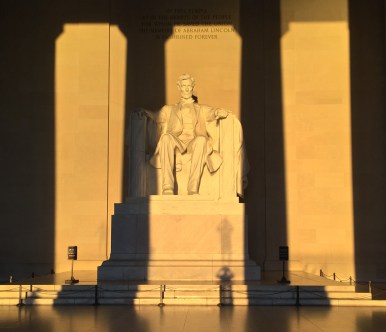 If Donald Trump asked me what he should consider in composing his most consequential address yet, I would advise him to go read the two greatest speeches in American history, which are conveniently inscribed on the walls of the Lincoln Memorial, behind an enormous stage that’s been erected there in his honor. I visit often, especially since November, to deepen my perspective on where we are in this continuing experiment.
On the Memorial’s south wall is the Gettysburg Address, which if Steven Spielberg is to be believed every Union soldier memorized. The president delivered it in November 1863, four months after the battle, when Union victories were crystallizing the U.S. government’s overwhelming advantages but also that the war’s course was far from over.
Lincoln’s public objective had been shifting since he wrote Horace Greeley in August 1862 that “My paramount object in this struggle is to save the Union, and is not either to save or to destroy slavery.” The month before, he had shared with his cabinet a draft of the Emancipation Proclamation, which he viewed as a military measure (freeing only slaves in rebel territories). Its preliminary issue, after the costly victory at Antietam in September, effectively changed the goal of the war. At Gettysburg 14 months later, his short address transformed its meaning.
The Address is a declaration. The war, Lincoln said, had become a test of the proposition that all men are created equal. He spoke over, and yet answered, South Carolina’s rationale for the Confederacy: the right of one identifiable group of people to determine the lives of Others and have the federal government uphold the Constitution’s Article IV clause that compelled states to return fugitive slaves. At his first inaugural, Lincoln had evoked the mystic chords of memory and the better angels of our nature to argue that he had no intention of interfering with slavery where it existed. At Gettysburg, by contrast, he dedicated the Union to “a new birth of freedom” – from slavery and of democratic government of, by, and for the people.
Where Gettysburg is a declaration of purpose, the Second Inaugural, on the Memorial’s north wall, is a humble inquiry into God and fate, after the president had written thousands more condolence letters. Lincoln never mentions the country by name, as if the inquiry might apply to any people. He identifies “a peculiar and powerful interest” – slavery – as “somehow the cause of the war,” before zeroing in on the contention. “Both parties deprecated war, but one of them would make war rather than let the nation survive, and the other would accept war rather than let it perish,” he says, before shifting to the passive expression, “and the war came.”
Then come the musings: that neither side anticipated the war’s cost and duration, nor “a result less fundamental and astounding”; that both read the same Bible and prayed to the same God, and invoked His aid against the other; that “it may seem strange that any men should dare to ask a just God’s assistance in wringing their bread from the sweat of other men’s faces, but let us judge not, that we be not judged.”
Then the proposition: If slavery were ordained, but now God willed to abolish it and so gave us this war as the price of having upheld it, is that not also God’s will? The question sets up Lincoln’s answer, the greatest sentence ever written about the American experience, capped by a fragment of the 19th Psalm: “Yet, if God wills that [the war] continue until all the wealth piled by the bondsman’s two hundred and fifty years of unrequited toil shall be sunk, and until every drop of blood drawn with the lash shall be paid by another drawn with the sword, as was said three thousand years ago, so still it must be said ‘the judgments of the Lord are true and righteous altogether.’” We have yet to sink that wealth.
The closing is well remembered: a plea to bind up the nation’s wounds. But the power of the speech is in Lincoln’s question and answer: If we are but bit players in God’s design who strive to honor it though we do not know it, perhaps we should be less certain of our judgments and more mindful of our obligations: “to care for him who shall have borne the battle and for his widow and his orphan.”
What question might the president-elect pose to us in his inaugural? Is he reflecting on his post-election tweets, and how they have exacerbated our division and degraded his standing (as measured by “phony polls”)? We are far more diverse than were our forebears when Lincoln spoke at the Capitol. Americans no longer read from the same Bible nor pray to the same god. Would that this next president be less certain of his judgments and, with malice toward none and charity for all, embody “all which may achieve and cherish a just and lasting peace among ourselves and with all nations.”
 Transformational Citizenship