Jim Crow makes a last stand in the Old Dominion

“Don’t boo. Vote.” – President Obama at the Democratic Convention

572779f0b58c9.image

Virginia House Speaker William Howell and Senate Majority Leader Thomas Norment

The struggle to do just that goes on, as illustrated by three recent court decisions.

In two federal cases, appeals courts struck down voter ID laws in Texas and North Carolina. In the Texas case, the Fifth Circuit on July 20 affirmed the trial court’s finding that the 2011 law had a racially discriminatory effect, as 608,000 registered voters – about one in 20 – lacked the required voter ID and faced obstacles to obtaining one in violation of the Voting Rights Act. It remanded the case to District Judge Nelva Gonzales Ramos for a remedy and reconsideration of whether the legislature acted with discriminatory intent. For North Carolina, the Fourth Circuit on July 29 reversed a trial court, finding the state’s 2013 law (and as amended in 2015) was enacted with racially discriminatory intent in violation of the Voting Rights Act and the 14th Amendment.

In their analyses, both appeals courts applied the tests of a 1986 Supreme Court case, Thornburg v. Gingles: whether racial polarization – meaning that the race of a voter correlates with a candidate or candidates – renders minority voters vulnerable to the tendency of elected officials to entrench themselves by targeting groups unlikely to vote for them.

Gingles would have been handy in the third court case, Howell v. McAuliffe, in which the Virginia Supreme Court on July 22 invented a limit on the governor’s authority to restore ex-felons’ voting rights. The plaintiffs, House Speaker William J. Howell and Senate Majority Leader Thomas Norment, both Republicans, successfully argued that they had standing as to sue Democratic Governor Terry McAuliffe and then achieved a reversal of his executive orders restoring voting rights to 206,000 ex-felons who had completed their sentences and any parole and probation. The court instructed state officials to strike from the voter rolls citizens who had registered per McAuliffe’s orders, issued in April, May and June.

Under Article II Section 1 of the Virginia Constitution, “No person who has been convicted of a felony shall be qualified to vote unless his civil rights have been restored by the Governor or other appropriate authority.” Under Article V Section 12, the governor may “remove political disabilities consequent upon conviction.”

In the 4-3 decision, Chief Justice Donald Lemons wrote that McAuliffe’s orders broke precedent by applying his power to an “indiscriminately configured class . . . without any regard for their individual circumstances and without any specific request by individuals seeking such relief,” contrary to the disqualification provision. To get there, the majority reasoned that the governor had “inverted” the disqualification provision, because under his order, “no person who has been convicted of a felony shall be disqualified to vote unless the felon is incarcerated or serving a sentence of supervised release. (Emphasis in original.) In so doing, the governor also violated Article I Section 7: “That all power of suspending laws, or the execution of laws, by any authority, without consent of the representatives of the people, is injurious to their rights, and ought not to be exercised.”

Huh?

In their dissent, Justices Cleo Powell and Bernard Goodwyn reviewed the debate around the governor’s clemency power that led to the Constitution of 1870, which remains unchanged: the legislature rejected any limits on it. Next, they wrote, the majority ignored the plain language of the Constitution and the governor’s order, announcing “an innovative ‘rule-exception sequence’ inversion theory.”

As for the suspension clause, the dissenters wrote, the governor “would be ‘suspending’ the law each time he removed a person’s political disabilities,” whether individually or as part of a group. “[T]he people of the Commonwealth have given their consent to the Governor’s suspension of the law within the limitations set out in the Restoration Clause.” They added, “[T]here is no dispute that a governor’s exercise of such clemency power on an individual basis does not violate the Suspension Clause.” In other words, the suspension clause is irrelevant.

But before they arrived at the merits, the court had to grant the legislators (and four other voters) standing to bring the case. That is, under Virginia precedents, they had to “demonstrate a direct interest, pecuniary or otherwise, in the outcome of the controversy that is separate and distinct from the interest of the public at large.”

Powell and Goodwyn, and in a separate dissent Justice William Mims, argued that the plaintiffs “have failed to make any showing of injury in fact. Rather, they merely claim that they, along with every other voter in the Commonwealth, have had their voting rights diluted. Such an injury could hardly be considered personal.”

To grant standing, the court’s majority were persuaded by the precedent cited by Howell: a 2002 racial gerrymandering case, in which those plaintiffs had shown a “particularized injury” in that, as Powell and Goodwyn noted, they were “denied equal treatment because of the legislature’s reliance on racial criteria.” But that was not present in Howell, the dissenters wrote: The effect on, or damage to, the plaintiffs by “dilution” of their vote with the addition of 206,000 more potential voters is no different than that to any other. The plaintiffs’ interest is indistinct from that of the general public, unless one accepts that all those ex-felons threaten the GOP’s legislative majorities.

What’s ironic in citing a racial gerrymander case to find standing is that the Republican legislators’ interest in McAuliffe’s order is its political effect. As the Fourth and Fifth circuits found, the voter ID laws were racially discriminatory. So is Virginia’s disenfranchisement, a constitutional provision dating to 1830 and emphasized for its effect on “darkies” (future U.S. Senator Carter Glass’s appellation) in the constitutional convention of 1902. As of 2010, 243,000 African Americans – 20 percent of the state’s black population – were disenfranchised ex-felons. Blacks account for 46 percent of the disenfranchised population but 19 percent of all residents. (More than 7 percent of the Virginia’s total population is disenfranchised. Only one state has more disenfranchised residents: Florida, the subject of a prior post, in which I reviewed America’s history of disenfranchisement as a racial weapon.)

In filing suit, Virginia’s GOP complained that McAuliffe, an ally of Hillary Clinton, was attempting to gain a Democratic edge. If that’s the case, the Republicans are trying to limit it – as the Supreme Court articulated 30 years ago in Gingles.

McAuliffe vowed he would not be deterred: he promised to set up auto-pens to sign 206,000 clemency orders. Virginia’s voter registration deadline is October 17. It will be an interesting fall.


Posted in civil rights, Uncategorized, Virginia legislature, Voting Rights Act | Tagged , , , , , , , | Comments Off on Jim Crow makes a last stand in the Old Dominion

Buchanan, Trump and the high-water mark of the tea party

BuchananIn the summer of 1992, I walked the floor of the Republican National Convention as Pat Buchanan roused the delegates with his “culture war” speech. Embracing the experience as the reporter I was, I felt their fury at having been wronged, denied, marginalized.

Buchanan had begun blowing the dog whistle of racial politics as an aide to candidate Richard Nixon in 1968, the same year segregationist George Wallace won five Southern states. Between his White House years for Nixon and Ronald Reagan, he was a columnist and pundit. That summer of 1992, he had lost his challenge to President George Bush. Now he stood before the convention.

“There is a religious war going on in this country . . . For this war is for the soul of America. And in that struggle for the soul of America, Clinton & Clinton are on the other side, and George Bush is on our side.” Buchanan cited his support for taxpayer-funded religious schools and school prayer, his opposition to abortion, gay marriage, pornography, and women in combat roles. He ended by blowing the dog whistle: recalling his meeting with federal troops called up four months before to quell the South Central riots in the wake of the acquittal of the police officers charged in the beating of Rodney King. “And as those boys took back the streets of Los Angeles, block by block, my friends, we must take back our cities, and take back our culture, and take back our country.”

Most of Buchanan’s bill of particulars is ancient (except in the latest GOP platform). The Pentagon has moved beyond women in combat to a transgendered service. The Supreme Court has reaffirmed Roe v. Wade. Same-sex marriage was the law in 32 states before the high court extended it to the rest.

But five decades after Barry Goldwater invented the Southern Strategy, the children of those targeted voters – identity-conscious, working class whites – have taken over the GOP. The establishment wing remains bewildered by Donald Trump, but it shouldn’t. Without the flip of Southern whites in reaction to Lyndon Johnson’s invocation of “We Shall Overcome,” the GOP would not have dominated quadrennial politics from 1968 to 1992. Had the Democrats not nominated two Southern governors in 1976 and 1992, the GOP run might have continued until 2008, when the new demographic – created by Johnson’s opening of immigration from Asia, Africa and Latin America – began to propel a run for the Democrats, who bet on inclusion.

In the aftermath of Barack Obama’s two successful campaigns, America is fundamentally changed, but action/reaction remains a law of politics as well as physics. The tea party of 2010 gathered the energy I had experienced in Houston, and the GOP establishment was thrilled to use it. Now the tea party is in control, its earlier constitutional complaints sublimated to racism and xenophobia. Trump led the “birthers.” His presidential platform reflects his “authenticity,” say his voters: anti-immigrant, anti-Muslim, protectionist. It’s Buchanan’s: “take back our culture, and take back our country.”

Identity politics remains our underlying narrative, but most of the country, including the GOP establishment, has moved on. It embraces immigration and globalization as fundamental to business. Now the establishment has a standard-bearer whose proclamations are at war with its interests. If the Democrats weren’t about to nominate the poster girl for a generation-long culture war, this election would be no contest. In the end, I doubt it will be.

Of course, the Republican Party remains ascendant in the House and many states. It’s been clever with gerrymandering and voter suppression, and it benefits from the clustering of the emerging America in the cities, compacting its political influence, and from the constitutional compromise that gives relatively conservative, sparsely populated states and liberal, urbanized states equal Senate representation. My guess is, after Trump is flushed out, that rather than disturb the marriage between the overseers and the base, the GOP will muddle along for a while yet.

Posted in Congress, election campaign, Uncategorized, Voting | Tagged , , , , , | 1 Comment

On the 4th of July: What is pride in country?

omaha_beach_01My feed today has lots of posts expressing pride in being American. I don’t share it. I am grateful to live in a country that affords me comfort and relative security. But I owe almost all of my good fortune to those who came before me: my parents, their wealth and values; their parents, who provided for them; the context in which I have lived – neighborhood, community, schools, employers and clients, governments.

Pride is what I feel in accomplishment – my hand in my grown children, my efforts in my relationships, volunteer projects and professional contributions. My gifts to America are infinitesimal.

Pride in identity is dangerous. Nothing wrong with its light side (“I feel good about my people”; “I love the Nats”), but it easily descends into darkness: My view is right; my beliefs are superior; my tribe is better. The justification for violence is “We are better” – at root, “I am separate.”

I take the opportunity not to be proud but grateful for all who came before me, and I declare to build on their legacy, to pay it forward. And I am grateful to pay taxes.

Posted in Uncategorized | Comments Off on On the 4th of July: What is pride in country?

Donald Trump gives the GOP its comeuppance

images-1Upon signing the Civil Rights Act of 1964, Bill Moyers related decades later, President Johnson said, “I think we just delivered the South to the Republican Party for a long time to come.”
It’s a popular story (though its truth is suspect), and it feels right for those who see race as America’s defining political narrative not only since 1964 but 1619. In fact, the Old South’s embrace of the GOP took a few decades. Richard Nixon’s Southern strategy and Ronald Reagan’s advocacy of states’ rights advanced it; Jimmy Carter and Bill Clinton, as sons of the South, mitigated it. Barack Obama cemented it.

The South became the cornerstone of the GOP’s congressional dominance in 1994, thanks to a coalition of economic and social conservatives. After the 2010 and 2014 elections, the tea partiers – roused after the election of the nation’s first black president – handed Republicans a record number of state legislatures. Like their congressional counterparts, they cut taxes for the wealthiest, rolled back economic regulation, and thwarted implementation of Obamacare. They also imposed citizenship and ID requirements to vote, reduced early-voting, drew gerrymandered districts, and with help from the Supreme Court undercut the effectiveness of the Voting Rights Act of 1965.

Debatable is the extent to which appeals to race have spawned the political realignment of the nation and especially the South. Indisputable is the loyalty of African Americans to the Democratic Party since Johnson used his overwhelming congressional majority to enact the Voting Rights Act, marking the beginning of the slow desertion from the party of working-class whites.

It’s conventional wisdom that presidential advisers from Pat Buchanan (architect of the South strategy) to Lee Atwater (creator of George H.W. Bush’s 1988 Willie Horton ad) to Karl Rove were expert at using race and class resentment to boost the GOP and its traditional agenda: advancing business interests.

At the start of the 2016 campaigns, the GOP coalition seemed to be intact, thanks to Obama. All the Republican candidates produced tax plans benefitting the same interests Reagan had championed. All pledged to repeal Obamacare (and none presented principles to replace it). Backed by action in the House, all promised to halt the trickle of Syrian refugees and to varying degrees discourage the immigration of Muslims and Latin Americans. Also backed by congressional Republicans, all favored “defunding” Planned Parenthood.

In the wake of Donald Trump’s victories in 10 of the first 15 primaries, the Republican establishment is freaking out, particularly over Trump’s alleged failure to disavow David Duke. The KKK apparently is over the edge, leading the House speaker and the Senate majority leader to condemn their party’s front-runner. It was the second time in a month Paul Ryan had criticized Trump, and Mitch McConnell was reported to have told colleagues he would drop Trump “like a hot rock” to protect Senate incumbents.

As McConnell recognized, the problem is not Trump as cause but as consequence: He’s taking dynamite to the party’s governing coalition. The establishment cares about taxes and regulation of commerce, and it draws social and religious conservatives with appeals to patriotism, Judeo-Christianity, and opposition to abortion (restrictions on which affect few Republicans who might want one).

Trump’s policy platform, to the extent he has one, is indistinct from his rivals and unimportant to his followers. His appeal stems from his anti-Obama “birtherism,” promise to wall off Latinos and Muslims, and pledge to “take the country back,” all with the most boorish rhetoric heard at least since Alabama’s George Wallace stood in the schoolhouse door.

Personally, I find the comparisons of Trump to Hitler, Mussolini and John Adams (who jailed opposition newspaper editors during his presidency) overblown. I have no idea whether Trump is more racist than the average American, but he appeals to those who are. He’s given his middle finger to the ways of the establishment, whose agenda has done little for the fortunes of wage-earners. The white working class – aware of its shrinking cultural significance and tossed to the margins of a low-wage, free-trade economy – is no longer buying what the planter class is selling.

Posted in civil rights, election campaign, gerrymandering, Uncategorized, Voting Rights Act | Tagged , , , , , , , | 1 Comment

Abraham Lincoln had it pretty good

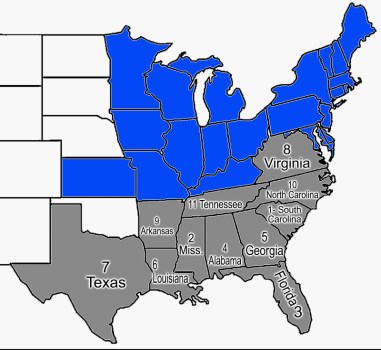
acw_secession

The 11 states in order of secession

When our 16th president was inaugurated, seven of the 11 Confederate states had already walked. South Carolina’s secession resolution, like those of other rebellious states, was unambiguous that slavery was the cause:

A geographical line has been drawn across the Union, and all the States north of that line have united in the election of a man to the high office of President of the United States, whose opinions and purposes are hostile to slavery. He is to be entrusted with the administration of the common Government, because he has declared that that “Government cannot endure permanently half slave, half free,” and that the public mind must rest in the belief that slavery is in the course of ultimate extinction.

With the departure of Southern Democrats, the Republican majority implemented an agenda that had been building for a decade. The 37th Congress was among the most productive of any, before or since, and laid the foundation for the United States as we know it. Among its many achievements, I note four that resonate today:

  1. The first income tax, passed to fund the war
  2. Authorization of the first transcontinental railroad, facilitated by giving railroad companies millions of acres of federal land
  3. The Morrill Act and the Department of Agriculture, which together fostered the world’s greatest system of higher education and a revolution in farming technology, paving the way for leaps in productivity and the development of modern urban life
  4. Abolition of slavery in the District of Columbia (followed by passage of the 13th, 14th and 15th Amendments within the decade)

On this Presidents Day (honoring the birthdays of Lincoln and Washington – but not others, such as Pierce’s and Buchanan’s), I’m pondering whether a little secession is just the ticket to break the stalemate in Congress. Suppose the former Confederate states again took a walk. What corresponding achievements might a 78-member Senate pass?

  1. A reformed Internal Revenue Code that taxes a greater percentage of Warren Buffet’s income than that of his secretary?
  2. A well funded infrastructure program that expands highways and public transportation, replaces water and sewer systems, and gives regulators the authority to ensure public safety?
  3. Expanded federal aid to higher education, to ensure that graduates enter the labor market without career-determining debt?
  4. A modernized voting system that puts the onus on government to ensure that citizens are registered and free to exercise the franchise?

Then those 11 Southern states (including my own, Virginia) could go on with their dream of minimal government (in some respects) reliant on regressive taxation.

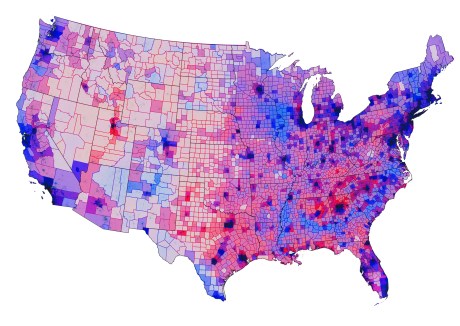
WhatAmericaLooksLike-2012Election-ChrisHowardOf course, the challenge is that our national disputes do not conform to neat geography, as recent results of the Electoral College show. A swath of the Plains glows as red as the Deep South, and the West Coast is as blue as the Northeast. All over the country, the red/blue maps are inaccurate, as most counties have varying purple hues, according to illustrator Chris Howard, who created an image of the 2012 presidential vote by county.
Besides, as Lincoln understood, the logic of secession could be replicated in Oregon as well as Alabama. The United States, after only 70 years, was still an experiment in government, a collection of disparate states uneasily balanced between state and federal powers. It (or “they,” at the time) also had an original sin. The sin has been expunged, but the tendency of powerful minorities to suppress majorities remains, as the history of malapportionment, gerrymandering and voter ID laws shows.

We approach a divide nearly as great as Lincoln faced, though now it’s not a single, overarching issue but a range of values about the government’s reach into our personal, social and economic lives, from abortion to the minimum wage. Still, one value seems to be retarding a more perfect union: tolerance and respect for differences, embodied in the Constitution’s tension between majority rule and the protection of individual rights guaranteed by the amendments, particularly the 14th. In Congress and in the land, situational ethics has taken hold, as seen in the brewing dispute over whether the president should receive a Senate vote on his Supreme Court nominee.

Ruth Bader Ginsburg seemed to capture this missing spirit of tolerance, inquiry, and rigor in her tribute to Antonin Scalia:

We disagreed now and then, but when I wrote for the Court and received a Scalia dissent, the opinion ultimately released was notably better than my initial circulation. Justice Scalia nailed all the weak spots . . . and gave me just what I needed to strengthen the majority opinion.

That sets me thinking about what makes the high court different: Its majorities are assembled by persuasion. The justices must listen to each other and then, with each vote counted, decide difficult questions.

It’s a practice our political bodies could emulate. As President Obama remarked last week about his time in the Illinois Senate, “We didn’t call each other idiots or fascists who were trying to destroy America. Because then we’d have to explain why we were playing poker or having a drink with an idiot or a fascist who was trying to destroy America.”

Posted in Abraham Lincoln, Congress, Supreme Court, U.S. Constitution, Uncategorized, Voting | Tagged , , , , , , , , , | 1 Comment

Ten reasons I quit watching football

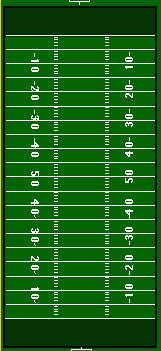
american_football_fieldAs a hundred million viewers turn on the 50th Super Bowl, I offer 10 perspectives on turning it off.

My football viewing ended after the 47th edition, when in a moment of clarity I turned to other items of interest. It had been waning, especially after the networks lengthened the TV time slot for NFL games from 3 hours to 3:15 and made rules changes to expand the window for commercials. (I admit as a contributing factor the incompetent ownership of my hometown team, Washington.)

For a while I’ve pondered football as a metaphor for our time in the nation’s history: a mechanized, standardized product with players rotating on and off, identifiable only by their uniform numbers – I can’t actually see them. Violence is intrinsic and injury is certain, but the image management projects is indestructibility (consider the on-screen Transformer robot Fox Sports displays during sponsorship announcements). Unlike in boxing, a faded sport in which we sense the damage of each mano-a-mano punch to a half-naked body, in football injuries are cloaked. Like the drone warfare on which our real wars increasingly rely, football plays out as a kind of virtual reality.

What does this pastime say about our culture? Like Rome’s gladiators, football stands in for a military empire based on acquisition and consumption: a distracting, violent spectacle that juices our adrenaline, as does a good war movie, between interminable commercial breaks.

If you’re still with me, consider a few questions:

  1. When a sport gives a third of its players brain disease and destroys the bodies of most, is it time to find another rooting interest? Perhaps the mounting reports of CTE and other injuries are contributing to the modest decline in high school football participation. Several players have cited the risk to their health in walking away from their livelihoods: not worth it.
  2. As an NFL fan, am I not endorsing having my tax dollars used for the monopoly business of one or more of 32 billionaire families? The public pays 75% of the operating cost of pro sports stadiums, estimates Judith Grant Long of the University of Michigan.
  3. How shall I respond to my alma mater, the University of Virginia, which this year charged students $657 for support of an $87 million athletic budget, most of it for football and basketball?
  4. College football used to be played on Saturdays – you know, a day when classes aren’t held. Now college administrators contract the unpaid players most nights of the week. Schedules feature many games against distant teams, further cutting into campus time. What’s my vote?
  5. Speaking of time, is a three-hour TV show the best use of mine on any given Saturday or Sunday, or any other night of the week, from late summer to midwinter?
  6. What is my responsibility as a fan when the NFL, major colleges, and some police departments protect players who rape women?
  7. I like scantily clad models as much as the next real man, but what is the relationship between the NFL’s cheerleaders and the rest of the product, considering my previous question?
  8. When teams play with their fans’ loyalties by relocating in search of more lucrative deals, shall I continue to participate?
  9. About those occasionally clever Super Bowl ads: beer, cars, snacks and soda, etc. at a half-billion (tax-deductible) dollars per 30-second message. Do I support what the broadcast is selling?
  10. So this is the free market at work: oversized men trading their health for money and fame, crass commercialism, orgies of consumption, drinking bound to fandom, all riding the bandwagon of “wholesome” athletic competition? Is this my concept of freedom?

We like the violence. We like the taxpayer subsidies. We think we’re connecting with our friends when we gather to watch the spectacle. That’s what Roger Goodell wants us to think. I don’t.

No wonder no one has invited me to a viewing party. That’s okay, pitchers and catchers report in two weeks.


Posted in Tax, Uncategorized | Tagged | Comments Off on Ten reasons I quit watching football

Which path toward a more perfect union?

2000px-Flag_of_IowaI’m glad I don’t vote in Iowa – for a ton of reasons, including I don’t have to make a choice today.

Most quadrennials, I’m neutral in the primaries, focused on the end game. Eight years ago I was passionate about Obama because of his eloquence and the vision he presented in Boston in 2004 and again in Philadelphia in March 2008. Hillary was fine with me – I met her on Capitol Hill in 1994 when she was advocating an on-the-way-to-single-payer health insurance plan, and she charmed me – but I had no interest in the return of Bill.

The Democrats this time around gave themselves a thin field, much as they did in 1992, when President Bush’s 90% approval rating in the wake of Iraq War One chased away most contenders, leaving room for the audacious “man from Hope.” We ended up with a masterful politician who knitted together enough of the Democratic coalition to beat back the worst of the GOP’s increasingly reactionary proposals, including that impeachment fiasco. His lack of personal integrity was a factor in Al Gore’s loss, ushering in the worst eight years of the American presidency since Franklin Pierce/James Buchanan, a one-two punch of incompetence and mendacity that nearly destroyed the republic.

Despite the anger of the electorate, we’re not in terrible shape. Obama has done well considering the opposition’s intransigence since day one, preventing adequate economic stimulus during the financial crisis and tweaks to a health care law that could work better, cover more people and cost less.

As the Framers intended, the big problems we confront are up to the first branch: adequate funding for education (see: college debt bomb), infrastructure (Flint), clean energy (California’s methane leak) and other investments that only the federal government has the political and financial wherewithal to address. The growing political and financial power of the elite and the diminishing security of the rest of us have both ends of the electoral divide inflamed. Congress, whose two chambers operate by minority rule, is unlikely to address any of these concerns, no matter who wins the White House.

The worst outcome, which the voters rejected 10 years ago, would be the current version of the GOP in control of the White House, Congress and the Supremes, with the opportunity to replace Justice Ruth Bader Ginsburg with another Samuel Alito. I would expect more comforting of the comfortable – decisions like Citizens United, which swept away decades of campaign finance law; Shelby County v. Holder, which eviscerated federal voting rights enforcement; and DirecTV v. Imburgia, which empowered corporations over customers.

So the question is: Who’s more likely to stitch together another Democratic coalition, drawing in the slice of true independents required to win, and then, if not execute an idea of how to save democratic capitalism from the rapaciousness of the let-them-eat-cake class, stop them from taking control?

Posted in Congress, election campaign, Supreme Court | Tagged , , , , , , | Comments Off on Which path toward a more perfect union?

Model of consistency

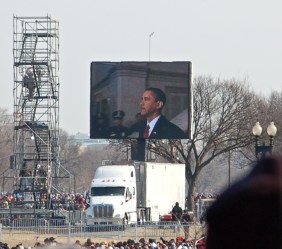
Obama

President-elect

Consider the nation when Barack Obama first swore the oath:

On that occasion seven years ago, the first African-American president told us:

We are shaped by every language and culture, drawn from every end of this earth; and because we have tasted the bitter swill of civil war and segregation, and emerged from that dark chapter stronger and more united, we cannot help but believe that the old hatreds shall someday pass; that the lines of tribe shall soon dissolve; that as the world grows smaller, our common humanity shall reveal itself; and that America must play its role in ushering in a new era of peace.

Consider where we are now:

  • Living with an economy that grows modestly, and sensing that few will experience job security
  • Fearing a different terrorist network whose confederates’ mass murders occur far less frequently than those of neighbors acting on disparate grudges
  • Engaged in diplomacy with enemies, the fruit of which includes the release within a day of U.S. sailors drifting into Iranian waters
  • In the midst of a typically divisive presidential campaign, dominated by one party’s contest whose themes are fear, lost standing, tribal identity (religion, party, ethnicity) and military projection

In his final State of the Union message, President Obama began by drawing on Lincoln’s second annual message to Congress (the inadequacy of dogmas of the quiet past) and ended on a rhythm drawn from King. But he hit the same theme he had in his first presidential speech: Diversity is our strength.

The world respects us not just for our arsenal, it respects us for our diversity and our openness and the way we respect every faith. His Holiness, Pope Francis, told this body from the very spot I’m standing on tonight that “to imitate the hatred and violence of tyrants and murderers is the best way to take their place.” When politicians insult Muslims, whether abroad, or fellow citizens, when a mosque is vandalized, or a kid is called names, that doesn’t make us safer. That’s not telling it like it is, it’s just wrong. It diminishes us in the eyes of the world. It makes it harder to achieve our goals. It betrays who we are as a country.

It will not be enough to reject tribalism, the president said in moving to his fourth of four questions: “How can we make our politics reflect what’s best in us?” We must embrace the meaning the Constitution’s preamble: We the People . . . in Order to form a more perfect Union.

“The future we want, all of us want – opportunity and security for our families, a rising standard of living, a sustainable, peaceful planet for our kids – all that is within our reach.” But not if we and those we elect insist on being right.

Facing the camera, Obama advised that if we want a better politics, changing the cast of characters is insufficient. “We have to change the system to reflect our better selves,” alluding to the last phrase of Lincoln’s First Inaugural. He named three ways: ending gerrymandering, “the practice of drawing our congressional districts so that politicians can pick their voters”; reducing “the influence of money in our politics, so that a handful of families or hidden interests can’t bankroll our elections”; and easing the process of voting (the most difficult among Western democracies). Those changes, not in whom we elect but how, “will only happen when the American people demand it.” In other words, when we decide that the fairness of the process is more important than the outcome.

Great SealLike any other citizen, I have my differences with Obama – where he’s gone too far in one direction or another, misplayed his hand with a recalcitrant opposition or defied the limits of executive authority. What I have admired about him, regardless of his policies, is his consistent vision, temperament, and appeal to the better angels of our nature. Regardless of race, creed, origin or orientation, we are bound by a common creed, he said last night. Proposed in 1782, it’s on the seal: “out of many, one.”


Posted in Uncategorized | Tagged , , , | 1 Comment

The girth of the tax code – in one provision

form 1040Ever wonder about line 23 on your annual Form 1040? In 2002 Congress created a temporary $250 “above the line” tax deduction to acknowledge teachers for the money they spend on classroom materials that their employers won’t.

Teachers spend several hundred dollars a year out of their own pockets; the provision gives them about 25 cents on the dollar (the marginal tax rate of most teachers) in the form of a tax refund – that is, about $62. The original provision applied only for 2002 and 2003, was estimated to cost $400 million, and was tucked in a $42 billion grab-bag of new and old tax cuts intended to stimulate an economy spooked by the 9/11 attacks.

Thus this token to our teachers became one of a growing list of “extenders,” temporary tax provisions that Congress, after a lot of teeth-gnashing, has extended for a year or two since the 1980s. The teeth-gnashing is part of the drama of (routinely) deciding to put the cost on a credit card. The last time our legislators went through this exercise, 12 months ago, the educator expenses deduction still had an estimated cost of $200 million, one of 62 one-year gifts to businesses and individuals with an estimated price tag of $42 billion.

Before it adjourns this week, Congress will pass a bill, the ‘‘Protecting Americans from Tax Hikes Act of 2015,’’ which would cut taxes net $622 billion over the next decade. As one of the bill’s 130-plus provisions, the educator expenses deduction would be made permanent, and the $250 limit would be adjusted for inflation. Eligible deductions would be expanded to professional development, in addition to classroom supplies. (Teachers already spend nearly four times the $250 limit, according to surveys cited by a pair of St. John’s University professors).

The number of tax-filing teachers claiming the deduction climbed from 2.8 million in its first year to 3.8 million in 2011, according to the St. John’s professors, and the cost of the deduction rose from $712 million to $962 million over the same period – far more than Congress estimated in either 2002 or 2015.

This is how Congress works. A legislator has an idea to spend money through the tax code. It gets enacted, often temporarily and almost always without an offsetting tax increase (it’s good to have your idea take off during a recession). Sometimes the idea is noble – who doesn’t want to support teachers? (Thus it’s cover for other ideas less noble with which it’s packaged.) Eventually the provision gains enough adherents and the time is opportune to make it permanent. Thus the spending goes on autopilot, without the bother of justifying it alone or compared to other priorities, or appropriating the money through the annual process. Nor is it subject to a cost-benefit analysis in an either big or small picture: Is this the best thing to spend money on, or the best way to support teachers?

What if we paid our teachers better? That’s not a concern of Congress, which just passed a big reform of federal support for K-12 education last week. But it feels good to give teachers $62 a year, especially since their students (who don’t yet vote) will be paying the bill – with interest.

Posted in Congress, Uncategorized | Tagged , | Comments Off on The girth of the tax code – in one provision

A political phenomenon crashes the season of hope

01-trump-tower-signDonald Trump is just the hired help.

A canary in a coalmine, the reality-show star is a measure of our civic health. Trump has held up a mirror, and his polling finds a slice of the electorate angry about our politics and responsive to a candidate who lacks substance but asserts that our problems can be easily solved, especially if the root of them is that aliens are threatening us.

Trump’s supporters do not constitute a yuuge slice of the electorate. Polls give him as much as 30 percent of first-place votes for the party nomination among identified Republicans, and identified Republicans amount to no more than a quarter of voters (according to the Pew Research Center). That’s about 7 percent. But he’s taking up a far greater share of the oxygen in this pre-primary phase of our elongated election process. Why?

First, he’s a traffic accident. Unpredictable, fascinating, provocative, revolting. “Did you hear what Trump said today?” Second, his pronouncements, other than the most personal and/or outrageous (from his insults of John McCain and others, to his call for banning Muslims), are not far from the center of gravity in the GOP primaries. To the extent he has policy proposals, most are in line with his chief competitors’. Third, his intimations that he would mount an independent campaign if he lost the GOP nomination pose an irresistible will-he-or-won’t-he drama for the media, leading to the question of how many voters would follow him.

My question concerns what about The Donald captivates our political culture, to the point than even I feel compelled to write about him. I don’t care what he says; I’m focused on his audience. If his draw as GOP nominee were equal to that of Barry Goldwater (who faced a popular incumbent and a nation still traumatized by the Kennedy assassination), that would be 48 million voters. Whatever the number, Trump is voicing fears of Other, contending that if we wall off those who threaten us – our identity, our culture, our jobs – we can keep what we have.

In an economy in which good-paying jobs and careers have been disappearing for 40 years, Trump’s wall makes more sense than what the parties are selling. Traditional Republican theory is that private investment enlarges the pie; traditional Democratic theory is that government’s leavening hand creates the conditions for a bigger pie. But the parties’ emotional fights are over a handful of social issues and how much to tax the rich, and their promises of pie aren’t working out. You don’t have to be a Trump supporter to worry that you may not make it to the finish line without becoming destitute, or that your kids won’t make it to the middle class. (My 24-year-old child’s stable job earns him the same wage I did as a temp 30 years ago.)

President Obama, trying to calm our jitters three days after a seemingly foreign-inspired mass murder, closed his Oval Office address by framing the debate around “keeping our country safe.” “Safe” is a post-9/11 word. Cold War leaders didn’t talk about “safety.” They talked about defending freedom. The president tried to tie the two together. “Let’s not forget that freedom is more powerful than fear; that we have always met challenges – whether war or depression, natural disasters or terrorist attacks – by coming together around our common ideals as one nation, as one people.”

Obama’s close died in the media’s commentary. We’re not buying oneness, and for many fear is beating freedom – except for the freedom to own a private arsenal. ISIS-tinged San Bernardino and anti-abortion-inspired Colorado Springs are self-inflicted wounds, both made possible by a political culture that sanctions the private ownership of weapons designed for mass murder. And so the cycle continues: fear chasing out reason, followed by vitriol, as we enter our annual season of hope. More like the winter of our discontent.

Posted in election campaign, Uncategorized | Tagged , | 2 Comments