The Pope and the Speaker

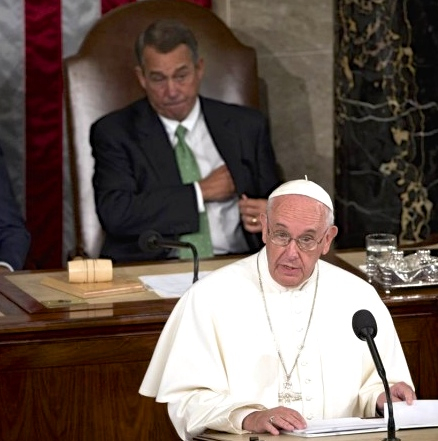
pope-addresses-congress-4-820x536A parent had arrived to remind the children of their purpose.

Each son or daughter of a given country has a mission, a personal and social responsibility. Your own responsibility as members of Congress is to enable this country, by your legislative activity, to grow as a nation. You are the face of its people, their representatives. You are called to defend and preserve the dignity of your fellow citizens in the tireless and demanding pursuit of the common good, for this is the chief aim of all politics. A political society endures when it seeks, as a vocation, to satisfy common needs by stimulating the growth of all its members, especially those in situations of greater vulnerability or risk. Legislative activity is always based on care for the people. To this you have been invited, called and convened by those who elected you.

Continuing his lecture from the well of the House of Representatives, Pope Francis instructed:

If politics must truly be at the service of the human person, it follows that it cannot be a slave to the economy and finance. Politics is, instead, an expression of our compelling need to live as one, in order to build as one the greatest common good: that of a community which sacrifices particular interests in order to share, in justice and peace, its goods, its interests, its social life.

In his September 24 address, Francis framed his message of wholeness through the lives of four Americans: Lincoln, Martin Luther King, the Catholic socialist agitator Dorothy Day, and the Trappist ascetic Thomas Merton. Its most powerful passage, which the pope related to migration waves into Europe and the United States, concerned the Golden Rule:

“If we want security, let us give security; if we want life, let us give life; if we want opportunities, let us provide opportunities. The yardstick we use for others will be the yardstick which time will use for us.”

The pope closed with a refined definition of greatness:

A nation can be considered great when it defends liberty as Lincoln did, when it fosters a culture which enables people to “dream” of full rights for all their brothers and sisters, as Martin Luther King sought to do; when it strives for justice and the cause of the oppressed, as Dorothy Day did by her tireless work, the fruit of a faith which becomes dialogue and sows peace in the contemplative style of Thomas Merton.

Sitting behind him, Speaker John Boehner took the pope’s message to heart. The next morning, he told the House Republican caucus over which he presides: I’m not up to the job.

At a press conference hours later, Boehner said, “I’ve done everything I can over my term as speaker to strengthen the institution. And frankly, my move today is another step in that effort to strengthen the institution.” What should citizens expect from the House after his departure? “If the Congress stays focused on the American people’s priorities, there will be no problem at all.”

Would that Boehner had acted as Francis prescribed:

A good political leader is one who, with the interests of all in mind, seizes the moment in a spirit of openness and pragmatism. A good political leader always opts to initiate processes rather than possessing spaces.

Recent congressional leaders – House and Senate, Republican and Democratic – have been about “possessing spaces”: representing their caucuses (and keeping their majestic offices), not serving the whole.

20150555678d553df89Boehner’s predecessor from 1999 to 2007, the avuncular Dennis Hastert, formalized a practice in which the House considers only proposals supported by a majority of the majority – that is, in many circumstances, a minority. The House has long operated as a 50-percent-plus-one institution, but under the Hastert rule the minority party is consistently ignored to serve the narrowest interest of the majority party. When Nancy Pelosi became speaker after the Democratic wave of 2006, she adopted a similar practice. That’s why Congress has so rarely in the past decade passed a budget or a highway bill, why the perfect remains the enemy of the good.

The “Hastert rule,” combined with two decades of methodical and mathematical gerrymandering, has created a House that cannot govern: The intransigent minority – especially rabid under the GOP – does not respect the reality that it may represent the passions of a dozen or two districts, but it does not represent America.

Boehner hamstrung himself by refusing to reverse Hastert’s legacy. In a September 27 interview on CBS’s Face the Nation, he recognized the box, but not that he had put himself in it.

“This whole idea that we were going to shut down the government to get rid of Obamacare in 2013, this plan never had chance,” Boehner said. “A lot of my Republican colleagues who knew it was a fool’s errand . . . were getting all this pressure from home to do this. And so we have got groups here in town, members of the House and Senate here in town who whip people into a frenzy believing they can accomplish things that they know are never going to happen.”

As speaker, Boehner let the damaging scenario play out – a 16-day “shutdown” – rather than protecting the institution and the government of which it is a part. Until his successor(s) makes a different choice – to recognize that most Americans prefer compromise to dysfunction – we will endure the same dynamic.

Posted in gerrymandering | Tagged , , , , | 1 Comment

Gerrymandering in Virginia: The legislature gets personal

435px-Virginia_presidential_election_results_2012

2012 presidential results by county

What happened in the Virginia General Assembly this week is a result of gerrymandering – the political process by which the political parties take care of themselves and ignore their constituents.

The events – a state Supreme Court justice and a federal court order to redraw U.S. House districts both ignored, and political parties bickering over whether the legislature is adjourned – have their origin years ago.

This version of the story begins with the state’s Senate and House of Delegates agreeing to each other’s district maps after the 2010 census. At the time, Democrats held a 22-18 margin in the Senate; Republicans controlled 61 of 100 House seats. With a new House map, Republicans in the 2011 elections achieved a two-thirds majority – 67 seats. Despite their confidence in the Senate map, Democrats lost two seats, and the 20-20 split threw control the Republicans, who held the lieutenant governor’s gavel. The Democratic sweep of statewide races in 2013 returned control to them – but only temporarily: In 2014, a Democratic senator quit to take a seat on a GOP-controlled state commission, and the  Republican elected in the special gave them a 21-19 advantage.

It bears noting that the General Assembly last spring passed a bill to swap some Senate precincts, with the expected effect of solidifying GOP control of one district. But Democratic Governor Terry McAuliffe vetoed the bill.

Back to the U.S. House districts (which I wrote about in February). The House of Delegates refused to consider redistricting in 2011, betting that Senate Republicans, with a GOP lieutenant governor, would take power in November, allowing complete control of the process in 2012. And that’s what happened. The Assembly ignored Governor Bob McDonnell’s citizen commission on redistricting and further solidified the GOP’s 8-to-3 domination in the House. Five of 11 winners in 2012 drew at least 60 percent of the vote; eight drew at least 60 percent in 2014, including Democrat Bobby Scott, who was unopposed.

3rd districtLast October, a three-judge federal panel rejected the map of Scott’s Third District, finding it impermissibly racially gerrymandered: Black voters comprise 57 percent, thus diluting the power of black voters generally. Black voter makeup in surrounding districts ranges from 15 percent to 32 percent. (The dissenting judge in the 2-1 decision wrote that incumbent protection had been the motive, not diminishing the power of black voters.) In June the panel ordered the legislature to draw new maps by September 1.

Thus McAuliffe set the date for the redistricting session – August 17. That irritated the Assembly’s GOP leaders, who wanted to run out their court appeals first. When McAuliffe on July 27 made a recess appointment to the Virginia Supreme Court, they saw a chance to get even. (A recess appointment is subject to legislative approval, and according to every press account I’ve read, the legislature has always confirmed the governor’s court appointments.) The GOP’s leaders, Senator Thomas K. Norment Jr. and House Speaker William J. Howell, announced August 2 that their caucuses would vote to replace Justice Jane Marum Roush, the first woman on the high court, with a choice of their own (a power not subject to veto). They griped that the governor hadn’t consulted them. (Under their plan Roush, who had served with distinction since 1993 as a Fairfax County circuit judge, would be out of a job.)

When the Assembly met August 17, a retiring GOP senator, decrying gotcha politics, voted against the confirmation of Roush’s replacement, Virginia Court of Appeals Judge Rossie D. Alston Jr. (an African-American whose record also is without blemish). The Democratic lieutenant governor broke the tie to defeat Alston’s appointment. Watkins then voted with the Democrats to adjourn the special session, leaving its main business – redrawing congressional maps – undone.

Meanwhile the House insists that it remains in session and that the Senate’s adjournment is unconstitutional: Therefore Roush is ineligible for another recess appointment; thus the seat would stand vacant. As for redistricting, that task falls to a federal court, barring a compromise by the political branches. If pigs could fly.

None of this has anything to do with serving the people. It’s more evidence of the corrosive power of gerrymandering: both parties pressing advantages, failing to talk, picking fights, and feeding the ire of their ever-safer voter bases.

It’s all about the base: Nothing in Virginia’s demographics point to a state House overwhelmingly controlled by the GOP, or a U.S. House delegation that is 8 to 3 Republican. Democrats have won the last three U.S. Senate elections and the last two presidential elections, and hold all three statewide posts. Aggregate voting for U.S. House seats was Republican by 2 percent in 2012, 14 percent in the 2014 off-year. The state Senate is probably representative of an increasingly purple state, with urban areas overwhelmingly blue and swaths of rural pinkish to red.

Virginia boasts of having the oldest continuous legislative body in the Western Hemisphere, dating to the 1619 election of the House of Burgesses in Jamestown. For decades state politicians lauded themselves for their “Virginia way,” a presumed remnant of Jefferson’s noblesse oblige. The Commonwealth with four of the first five presidents didn’t need ethics rules because the honor of service (current pay $18,000 a year) was the ethic. Those days are gone. The last governor is exhausting is final legal appeals, hoping to avoid prison on 11 federal counts of conspiracy, bribery and extortion.

“If we do this, all the cups in the cupboard are broken,” Democratic Senator A. Donald McEachin told The Washington Post before the vote on Judge Alston. “There are no more customs, usages or practices of the Senate that are worth a hoot.”

In Virginia, as across the Potomac, the new practice is to screw the other side, and let the constituents be damned. That’s not the problem, however. The problem is a constituency that shows the same disrespect for democratic principles and plain old courtesy in the civic sphere. Until We the People shift, it’s unlikely our representatives will either.

Posted in gerrymandering, Voting, Voting Rights Act | Tagged , , , , , | Comments Off on Gerrymandering in Virginia: The legislature gets personal

The Senate as kabuki theatre

5a37630rThe Senate’s vote this week on a bill to defund Planned Parenthood illustrates several forces that have converted the “world’s greatest deliberative body” into a mechanism of non-stop campaigning.

The impetus for the vote came from group that claims to be a 501(c) organization, the Center for Medical Progress, which released a series of videos about Planned Parenthood. I won’t characterize the videos; most people will bring their own meaning based on their positions. CMP is not my focus; rather it is illustrative.

On its Website, CMP defines itself as “a group of citizen journalists dedicated to monitoring and reporting on medical ethics and advances.” Each of the posts on its home page concerns “trafficking in baby parts.” Journalists – not. It’s an anti-abortion advocacy group. In a bit of surfing I found:

  • The IRS database of non-profit organizations does not include CMP
  • CMP is the creation of Live Action, another anti-abortion group that for years has produced sting videos, some contending that Planned Parenthood is engaged in sex-trafficking of minors

In bygone days, if congressional leaders were concerned that a federally supported organization were “trafficking in baby parts” (which is illegal), they might schedule a hearing and invite witnesses to testify, consider a bill in committee, and bring it to the floor for debate and a vote.

In addition to calling witnesses from Planned Parenthood, the committee might call in those involved in making and distributing the videos.

kentucky-senator-mitch-mcconnellSenate Majority Leader Mitch McConnell chose another path: Ally Joni Ernst (Iowa) introduced a bill to defund Planned Parenthood two weeks after the first of the CMP videos was released. Two days after that, McConnell brought up the bill and filed a motion to limit debate. Four days later, on August 3, the Senate debated the motion and then, under its 60-vote rule, declined to limit debate, effectively killing the bill.

Another kabuki dance: a story hyped by advocates manipulating social media, taken up in the Senate, which went through a predictable ritual not intended to effect legislative change but to generate heat, a bumper sticker for the next election. It happens frequently, though not often so fast.

The Senate’s filibuster rule is a prime mechanism of the dance. Because in this partisan era neither side can regularly attract 60 votes, no one is held truly accountable for his or her vote. If passage required a simple majority, senators would have to stand knowing that their vote mattered, instead of hiding behind the undemocratic super-majority.

An NBC News/Wall Street Journal poll last week found Planned Parenthood was rated 45 percent positive/30 percent negative. Among Democrats, Planned Parenthood enjoys a 69-percent positive view; 23 percent of Republicans view the organization positively. (In the same poll, the Democratic Party was viewed evenly negatively and positively; the view of the GOP was 28 percent positive, 44 percent negative.)

Do all Senate Republicans (except Mark Kirk of Illinois, a prime Democratic target in 2016) want to defund a 99-year-old organization supported by public and private funding that provides gynecological care to millions of women? We don’t really know.

We do know that staging a vote, without inquiry or reason, is easier than governing.

Posted in Uncategorized | Tagged , , , | Comments Off on The Senate as kabuki theatre

‘That cause for which they gave the last full measure of devotion’

Timothy O'SullivanOn this Memorial Day, I’m pondering the connection between our struggle for freedom and equality and the sacrifices of service men and women. Memorial Day was invented on May 30, 1868, as “Decoration Day.” Now it climaxes a three-day weekend marking the start of summer fun. In this way and many others, Americans forget their history. Often I write about our history because it is the context in which we have expanded – and contracted – our national oneness.

Decoration Day was a remembrance of the Civil War, which was a consequence of the worst-ever Supreme Court decision, in 1857: Dred Scott, in which Chief Justice Roger Taney wrote that a free Negro, descended from slavery, “is not a ‘citizen’ within the meaning of the Constitution of the United States.” Having nullified the Compromise of 1850, the court turned out politics in favor of arms.

The Supreme Court has often been our agent of expanding equality. Consider Brown v. Board (reversing its own “separate but equal” decision in Plessy) or United States v. Windsor (striking down the Defense of Marriage Act). But the courts also have been the agent of reaction, while the executive and/or Congress have driven creation – as was the case in the 1860s with the prosecution of the war and passage of the 13th, 14th and 15th amendments. Later came Congress’s generation of amendments expanding the franchise to women, D.C. residents, and 18-year-olds.

While African Americans continue to struggle for equality before all three branches, the courts have driven rights for LGBT persons, with rare same-sex marriage victories in the executive and legislature. Anticipating the high court’s gay-marriage decision in Obergefell v. Hodges, I read one of the amicus briefs, filed by the Mattachine Society of Washington, D.C. The brief details the executive branch’s “animus against LGBT Americans [that] fed the flames of hatred, revulsion, and disgust from which the current marriage bans arose.”

MSDC conducts archival research and educational programs on gay and lesbian history. With its pro bono counsel, McDermott, Will & Emory, MSDC’s brief focuses on the efforts of the Civil Service Commission (now the Office of Personnel Management) to roust homosexuals from federal jobs beginning in the 1940s. The brief states:

The historical background demonstrated by these original source materials reveals a culture of animus against LGBT Americans, justifications for excluding them from the privileges given to all other Americans, and a revulsion to any form of intimacy between individuals of the same sex. The voices of the government officials in these important documents, and the stories of the victims of these purges, show why government actions grounded in animus cannot stand.

34_dwight_d_eisenhower[1]One might suggest that FBI Director J. Edgar Hoover’s program to identify “sexual deviants” was rooted in the government’s Cold War loyalty investigations. But President Eisenhower’s 1953 Executive Order 10450 turned a largely political exercise under a Truman executive order into a broader effort to purge employees suspected of “any criminal, infamous, dishonest, immoral, or notoriously disgraceful conduct, habitual use of intoxicants to excess, drug addiction, or sexual perversion.” The CSC, supported by the FBI, was directed to execute Eisenhower’s order. The brief argues:

EO 10450 and the Sex Deviate Program were already powerful tools to implement the policy of running homosexuals out of the federal government. But, when combined with the CSC, the three became a potent poison that spread animus against homosexuals throughout all branches of the federal government and into the States.

In a 1964 memo, for example, a CSC supervisor wrote:

[O]ur society generally regards homosexuality as a form of immoral conduct. Also, our societal attitudes being what they are, a homosexual is extremely vulnerable to blackmail: exposure means public opprobrium, and, in the case of a Government employee the loss of his job. Thus, under the terms of the Order, past or present homosexuality renders the individual unacceptable for a sensitive position . . . [W]e set homosexuality apart from other forms of immoral conduct and take a more severe attitude toward it . . . The result is that our evaluations are quite subjective, depending on the strength of the reviewing official’s aversion to homosexuality in general and his reaction to the circumstances of the particular case at hand.

As the brief explains, the CSC’s purging of homosexuals preceded the Cold War and concerns over possible blackmail of officials, in sensitive positions or in lower grades. By 1950, the commission worked closely with a Senate subcommittee, which reported that “the public interest cannot be adequately protected unless responsible officials adopt and maintain a realistic and vigilant attitude toward the problem of sex perverts in the Government. To pussyfoot or to take half measures will allow some known perverts to remain in the Government.”

The CSC also relied upon the work of the states – or at least the work of Florida, where a joint legislative committee issued a 1963 report stating that “many facets of homosexual practice as it exists in Florida today pose a threat to the health and moral well-being of a sizable portion of our population, particularly of our youth.” (The introduction of the report is so sensational that it’s difficult to capture in a phrase or two; on the other hand, it quotes an arm of the MSDC that had predicted: “The time is coming when homosexual love will be accepted in America as it is now in some other cultures of the world.”) According to MSDC, the Florida report resulted in the firing of 37 federal officials.

Adverse court rulings eventually tamed the government’s urge to purge. But the MSDC brief has a footnote that brings the Eisenhower executive order full circle: The White House relied on then-Assistant Attorney General Warren Burger to defend the order. Burger, as chief justice three decades later, wrote a concurring opinion in Bowers v. Hardwick (1986), in which he called homosexuality “the infamous crime against nature,” an offense of “deeper malignity” than rape, and “a crime not fit to be named.” I have suggested that the court’s reversal of Bowers in Lawrence IMG_3117v. Texas (2003) set the course for the backlash among voters to same-sex marriage – a course that the court, from all signs, intends to end.

It is a particular for which no soldier likely has given his life over the past 150 years. But it is the cause of which Lincoln spoke at Gettysburg. We are still working on whether “of the people, by the people, for the people” means all of them.

Posted in LGBT rights, Supreme Court | Tagged , , , , | Comments Off on ‘That cause for which they gave the last full measure of devotion’

Bert Neuborne and ‘Madison’s Music’

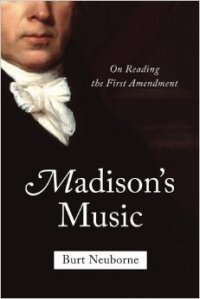
41VFJPPcqpL._SY344_BO1,204,203,200_Have you considered why the First Amendment is structured the way it is, or how the 10 amendments of the Bill of Rights came to be so ordered? Me neither, until I read Bert Neuborne’s new book, Madison’s Music: On Reading the First Amendment.

That James Madison was the primary author of the Constitution is a lesson from high school civics. More obscure is that Madison, as a member of the first House of Representatives, was also the prime author of the Bill of Rights, which he drafted in response to demands from the 11 states that had ratified the Constitution and the two that had refused.

Neuborne, a Supreme Court lawyer, New York University law professor and former legal director of the ACLU, walks readers through the history of the Bill of Rights and First Amendment jurisprudence, and argues that the contemporary Supreme Court has chopped the meaning of our fundamental freedoms into pieces devoid of the context in which Madison and the 1st Congress created them.

“Today we hear only broken fragments of Madison’s music,” he writes. “Instead of seeking harmony and coherence in the First Amendment, we read [it and the other nine] as a set of isolated, self-contained commands.”

Neuborne appears sympathetic to the challenge. “The majestic abstractions in the First Amendment . . . do not carry a single literal meaning.” Even “the phrase the freedom of is a legal concept that has no intrinsic meaning.”

Of course, this is the challenge of all words and all concepts: they are open to our interpretation. Those who argue that the words in the Constitution have a universal meaning are just as narrow as those who argue for a fundamental understanding of the Bible. The problem for American democracy is that nine unelected judges have been set up as the arbiters of our system. And according to Neuborne:

The result is an arbitrary constitutional jurisprudence that has left us with a dysfunctional, judge-built “democracy” owned lock, stock and barrel by five thousand wealthy oligarchs, a pseudodemocracy in which district lines have been carefully gerrymandered to rig the outcomes of most legislative elections, only half the population bothers to vote, and cynics erect barriers designed to disenfranchise the weak and the poor.

To return to Madison’s vision, he writes, we should read the text as a whole. The Constitution establishes the structure of the U.S. government; the Bill of Rights is the sheet music for how it is to be played by federal officials, the states, and the people.

The First Amendment contains 45 words:

Congress shall make no law respecting an establishment of religion, or prohibiting the free exercise thereof; or abridging the freedom of speech, or of the press; or the right of the people peaceably to assemble, and to petition the government for a redress of grievances.

Leaving aside the limiting phrase “Congress shall make no law,” the amendment sets the order in which democratic change occurs. First, it bars the government from designating a state-sanctioned religion. Then it protects the free exercise of religion – which, as Madison intended, includes secular conscience, the right to speak it, disseminate it, and gather to discuss and agitate for it. That, dear citizen, is how a political idea becomes reality.

The ordering of the other amendments is almost as logical. The Second takes up guns and nation’s defense and the Third protects against the Red Coats’ propensity to take citizens’ homes for the use of their troops. Neuborne reviews the fascinating drafts of the Second without comment; the Third has never required much attention.

Amendments Four through Eight concern, in order, a citizen’s rights when the government uses its power to compel: search and seizure; limits on evidence in court; right to a jury trial and counsel; rights in civil cases; and limits on punishment.

The Ninth is a correspondent to the First, enabling the courts to expand unenumerated rights, such as privacy, freedom of secular conscience, free association – and imminently, same-sex marriage. The Tenth runs the opposite way, circumscribing federal power.

As clearly as Neuborne places the Bill of Rights in historical context, and as much fun as he has detailing the weird history of Marbury v. Madison in which the Supreme Court asserted its power to interpret the law and the Constitution, his brief is the cramped interpretation of First Amendment freedoms under the current “hierarchical” 5-4 majority. It has “shied away from giving constitutional meaning to the textual protection of democracy that is the essence” of the First.

The problem, Neuborne writes, stems from Baker v. Carr, the historic one-man/one-vote case in 1962 in which the justices struck down malapportioned legislative districts based on the Equal Protection Clause of the Fourteenth Amendment. Precedents would have developed far differently had the court ground Baker in contextual First Amendment freedoms. And indeed, in a 1976 case, the court ruled that Equal Protection bars intentional discrimination, but does not address laws with disparate effects, so long as the discriminatory effect is unintentional. Thus, when in 2002 a legal team challenged Florida’s 144-year-old constitutional provision disenfranchising felons, lower courts cited precedent in ruling it irrelevant that one-quarter of the state’s black males couldn’t vote, unless the plaintiffs could prove the provision was enacted with a discriminatory purpose. The Supreme Court declined to hear the appeal.

indexThat’s one example of the “doctrinal silos” in which the justices have operated since Baker. Another is an “imperial Free Speech Clause,” which the high court has taken out of First Amendment context, ruling in a set of cases beginning with Buckley and climaxing with Citizens United that money equals speech and corporate rights are equivalent to human rights.

Neuborne cites four recent cases in which the court has proclaimed the rights of the speaker superior to the rights of the hearer:

  • United States v. Alvarez (2012) – in which the court struck down the federal Stolen Valor Act, which made it a crime to lie about having received military honors or decorations. Alvarez, a candidate for local office in California with no military record, claimed to have received the Medal of Honor. Neuborne contends the 6-3 decision stemmed from the justices’ fear of the government regulating speech “that is unsupported by any plausible concept of human dignity and that cannot possibly be thought to aid hearers in making our institutions function better.”
  • Snyder v. Phelps (2011) – in which the court reversed damages against Fred Phelps of the infamous Westboro Baptist Church for picketing a soldier’s funeral. Writes Neuborne of the 8-1 decision: “freedom of speech included a speaker’s right to hijack the funeral of a young soldier as a backdrop for their bigotry, despite the additional anguish imposed on the soldier’s family.”
  • Brown v. Entertainment Merchants’ Ass’n (2011) – in which the court struck down a California law that restricted sales to minors of violent video games. The 7-2 decision protected “the developers of violent video games pitching misogyny, torture and murder to kids for fun and profit,” again out of fear of the government’s regulatory power.
  • United States v. Stevens (2010) – in which the court, 8-1, struck down as overbroad a federal law criminalizing commercial creation, sale, or possession of certain depictions of animal cruelty.

In these and other cases over the last quarter-century, the court “tend[s] to tear out seven words – Congress shall make no law . . . abridging . . . speech – and read them as a deregulatory command forbidding any government interference with communication.” Under a contextual reading of the First Amendment, Neuborne argues, the rights of speakers (billionaire campaign financiers, media conglomerates, lying candidates, hateful picketers) would be balanced against the rights of hearers – voters (consumers) of one kind or another. The scales would be the government – specifically Congress, elected by We the People.

“Don’t get me wrong,” Neuborne writes. “I get nervous about government censorship. But I also get nervous about the Court’s fixation on speakers who run roughshod over others who live in the neighborhood. Recognizing a community of speakers and hearers doesn’t mean the overthrow of the speaker. But it is really necessary or wise to raise appalling speakers above the law just because we mistrust government ability to regulate them fairly?”

As a close observer of Congress over four decades, I have come to view the First Branch of government as that most to blame for our political dysfunction. Neuborne, who has been player in the Third Branch even longer, reminds me there is blame to go around. His book also includes the most moving dedication I have ever read.

Posted in Bill of Rights, James Madison, U.S. Constitution, Voting | Tagged , , , , , , | Comments Off on Bert Neuborne and ‘Madison’s Music’

“Civil Death”: Florida’s Criminal Disenfranchisement

imagesThe Honorable Rick Scott

Tallahassee, Florida

Dear Governor Scott:

Belated congratulations on your reelection in November. I don’t write to every governor, but as a non-resident, property-tax-payer who spends about half the year in the Sunshine State (summers too – I’m not just a snowbird!), I feel our connection. And I wanted to make sure you’re aware of my blog, because one of my regular themes is the importance of voting, so that all Floridians – and Americans – can say their government is legitimate, even if their candidates lose. Unless we vote, our democracy withers.

As I’m sure you know, you won by a margin of 66,000 votes (out of 5.6 million cast), with 43% turnout of eligible Floridians. According to the state elections department, half of the 11.9 million people registered to vote did so. I write to you about the 1,541,000 citizens who have lost the right to vote because of Florida’s restrictions on voting by felons and ex-felons. You’re at least vaguely familiar with the issue, since in your first term you reinstated – after a half-hour public hearing with no advance notice of the changes – 1975 rules that require even non-violent felons to wait five years after they have completed their sentences to apply, through a cumbersome process, for the right to vote.

The changes your clemency board made undid reforms, under fellow Republican Governors Jeb Bush in 2004 and Charlie Crist in 2007, that automatically restored voting rights to most felons upon release from prison. According to one newspaper, you told one of your clemency board members that your change “seemed reasonable” but offered no further insight into your thinking.

Allow me, then, to place your reasonableness in a larger context.[i]

America’s disenfranchisement laws date to the colonial period and have their precedents in the Enlightenment and Ancient Greece. They emerged from twin strains of thought. The liberal strain, reflecting John Locke, argued that citizens’ relationship with the state was self-interested and contractual – that they agreed to rules in exchange for increased security, and that by violating the rules, criminals lost the right to participate in their formation.

The republican strain, common in early New England, held that the “body politic” was not merely an agreement among self-interested persons but an actual body dependent upon “virtue.” Disenfranchising criminals was a matter of protecting the body from corruption. And so loss of the right to vote was a public aspect of conviction upon which courts passed specific sentence.

Both of these strains emerged when voting was severely restricted – to white, male, property owners. Over time, of course, we have adopted a much broader understanding of citizenship and voting rights. The Constitution nowhere mentions a citizen’s right to vote until the Fourteenth Amendment, and today Americans accept that it is the cardinal indication of democracy (even though roughly half of us bother to exercise the franchise).

With the growth of the country from a group of villages where the privilege of voting was concomitant with civic virtue and status, to a nation of 300 million strangers under relatively distant governments, what is the contemporary rationale for disenfranchising citizens? Criminal punishment is traditionally tied to one or more of four aims: retribution, incapacitation, deterrence, or rehabilitation. Disenfranchisement is retributive – it’s a denial of a right. But it’s also a “collateral” sentence, not handed down in court but automatic under a related code section. It is incapacitating only if the criminal had engaged in election fraud (locking up someone for larceny will incapacitate the opportunity to steal). It’s unlikely to be deterrent – who thinks about the right to vote while committing crime (unless, say, they’re rioting while officials are counting chads)? And it’s contrary to rehabilitation: studies have shown reduced recidivism for those whose voting rights are restored. So what is the purpose?

Well, Governor, it’s no accident that disenfranchisement became all the rage around the time Congress passed the Fourteenth (equal protection) and Fifteenth (voting rights for blacks) amendments. It was in the wake of Reconstruction that Florida rewrote its constitution to deny suffrage to felons – part of an effort across the former Confederacy to remove former slaves from the voter rolls. In fact, a number of states rewrote their constitutions to tie voting rights to crimes more commonly committed by Negroes. Thus conviction for theft and wife-beating resulted in disenfranchisement, while robbery and murder did not.

The state’s 1868 disenfranchisement provision was retained when in 1968, again amid a period of racial upheaval, Florida revised its constitution. What has expanded, however, is the list of felonies, especially since the launch of the drug war, which has exacerbated the disparate effect of disenfranchisement on white and black Americans. And in this category, too, Florida “leads” the nation. Florida’s total inmate population is 167,000 (all figures from The Sentencing Project). But as I noted above, 1.5 million Floridians – 10% of the voting population – are disenfranchised. Of that number, 520,000 are African-American – 23% of the state’s black population. Nationwide, 5.85 million Americans are disenfranchised, 2.23 million of them African-American.

It’s unlikely coincidental that the two states that have no provision for disenfranchisement of felons are Vermont and Maine – two of our whitest enclaves.

long-lines-at-pollsIn the context of minority voting, I remind you of the letter you got from Attorney General Holder last summer, taking you to task for the myriad ways Florida suppresses voting: reduced voting hours and early voting, reports of 200,000 discouraged voters in 2012, the purging of voting rolls – as well as Florida’s place topping the 11 states that indefinitely disenfranchise citizens. The A.G. wrote: “Generations of Americans took extraordinary risks and willingly confronted hatred and violence – including in your home state – to ensure that all Americans would have the chance to participate in the work of their government.”

So often in America, we return to what makes us unique: the mix of black and white that’s produced slavery, civil war, lynchings, jazz, rock ’n roll, our only decent cooking, New Orleans, and just about everything else culturally noteworthy.

My state of residency, Virginia, used to disenfranchise almost as zealously as Florida. In 2013, then-Governor Bob McDonnell under his own authority restored voting rights to ex-felons through a state administrative action that would allow them to register. Fortuitously, that may help your former peer, who is appealing his conviction for felony bribery.

You might want to consider that, Governor, in case after your service to the people of Florida you return to your former life as an executive of a Medicare contractor.

Cordially,

Bennett Minton

[i] I am inspired by Alec C. Ewald of the University of Vermont: “Civil Death”: The Ideological Paradox of Criminal Disenfranchisement Law in the United States, (March 24, 2012). Wisconsin Law Review, pp. 1045-1132, 2002. Available at SSRN: http://ssrn.com/abstract=2028335

Posted in civil rights, U.S. Constitution, Voting | Tagged , , , , , | Comments Off on “Civil Death”: Florida’s Criminal Disenfranchisement

A wake – or awake? – in Baltimore

msbc1k-b781165933z.120130829145801000gvd1fks1t.1

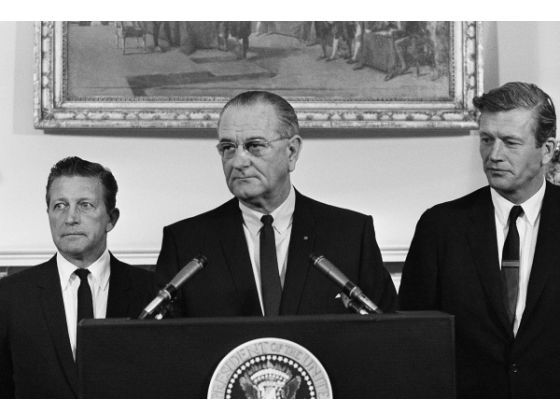
President Johnson, with commissioners Kerner and John Lindsey, 1967

After riots broke out in cities across the country in the summer of 1967, President Johnson appointed the National Advisory Commission on Civil Disorders. Known as the Kerner Commission after its chairman, Illinois Governor Otto Kerner, it issued a 426-page report that became a paperback best-seller. Much of it reads like the country 47 years later. It’s a challenge to highlight only a few passages:

Disorder did not erupt as a result of a single “triggering” or “precipitating” incident. Instead, it was generated out of an in­creasingly disturbed social atmosphere, in which typically a series of tension-heightening incidents over a period of weeks or months became linked in the minds of many in the Negro community with a reservoir of underlying grievances. At some point in the mounting tension, a further incident – in itself often routine or trivial – became the breaking point and the tension spilled over into violence.

Unlike today’s talking heads on cable news, the commission staff actually talked to people in the 23 communities where disorders had taken place. The report ranked their grievances:

  1. Police practices
  2. Unemployment and underemployment
  3. Inadequate housing
  4. Inadequate education
  5. Poor recreation facilities and programs
  6. Ineffectiveness of the political structure and grievance mechanisms
  7. Disrespectful white attitudes
  8. Discriminatory administration of justice
  9. Inadequacy of federal programs
  10. Inadequacy of municipal services
  11. Discriminatory consumer and credit practices
  12. Inadequate welfare programs

The commission’s recommendations emboded “a commitment to national action on an unprecedented scale [that] can shape a future compatible with the historic ideals of American society.” Its objectives included:

  • Opening up opportunities to those who are restricted by racial segregation and discrimination, and eliminating all barriers to their choice of jobs, education and housing
  • Removing the frustration of powerlessness among the disadvantaged by providing the means for them to deal with the problems that affect their own lives and by increasing the capacity of our public and private institutions to respond to these problems
  • Increasing communication across racial lines to destroy stereotypes, to halt polarization, end distrust and hostility, and create common ground for efforts toward public order and social justice

We lived in a different context five decades ago. Racial discrimination was as a matter of law as well as practice. Driven by a nation whose conscience had been awakened by Martin Luther King, an empathetic Congress acting under the leadership of Lyndon Johnson entered a legislative flurry, passing civil rights laws and spending money on an infrastructure to address inequality across a range of human needs: health, education, housing, and living standards.

Soon came the backlash. Richard Nixon ran for president on “law and order.” George Wallace’s 1972 presidential bid captured white angst at the government’s efforts to mitigate racial inequality. The prison boom began. After two oil “crises,” a presidential resignation, and a soul-sapping, 444-day hostage drama, Ronald Reagan’s inaugural contention that “government is not the solution to our problem, government is the problem” set a tone that still resonates, paralyzing our potential to act.

Today we have a president who identifies as black but no galvanized civil rights movement, a Congress and Supreme Court antagonistic to government promotion of equal opportunity, and an electorate disengaged from politics and fearful of its economic and social insecurity.

index

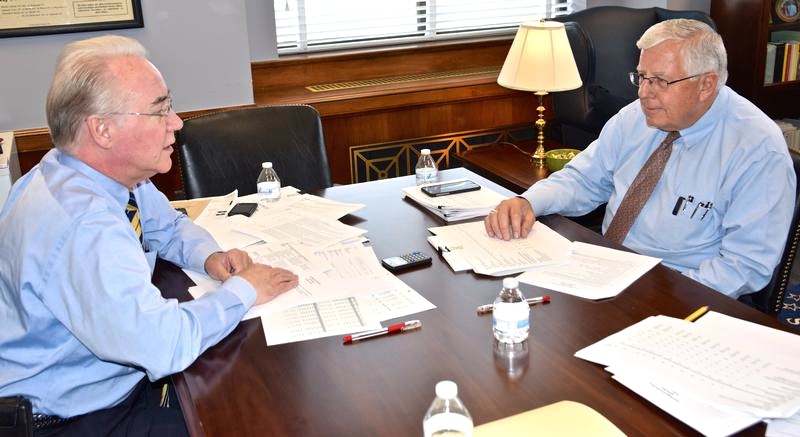
Budget writers: Representative Tom Price, Senator Mike Enzi

This week House and Senate Republicans agreed to a joint budget resolution, the internal congressional memorandum that instructs various committees how to write the annual spending bills. The details are to come later, but Republican leaders have targeted domestic spending items, among them college aid, low-income rent assistance, and food stamps. They support higher defense spending and repealing Obamacare. On rebuilding the nation’s infrastructure or addressing racial, social or economic inequality, the budget is silent.

The political response to Baltimore has been polarized. Fox News talking heads blame a “welfare mentality.” Republican candidates are mum. President Obama and Hilary Clinton note underlying issues. The Justice Department will investigate the Baltimore Police, as it did Ferguson’s.

But the electorate has yet to connect the dots: a hollowed-out, de-industrialized economy that no longer needs 15 percent of its workers; unequal K-12 schools and a system of higher education whose costs the government is unwilling to address despite the urgent need for a higher skilled workforce, and politicians who respond to discrete constituencies rather than to the whole.

When the electorate begins to connect the dots, it will be time for another Kerner Commission.

Posted in civil rights | Tagged , , , | 2 Comments

‘Disappeared’ from the African-American community

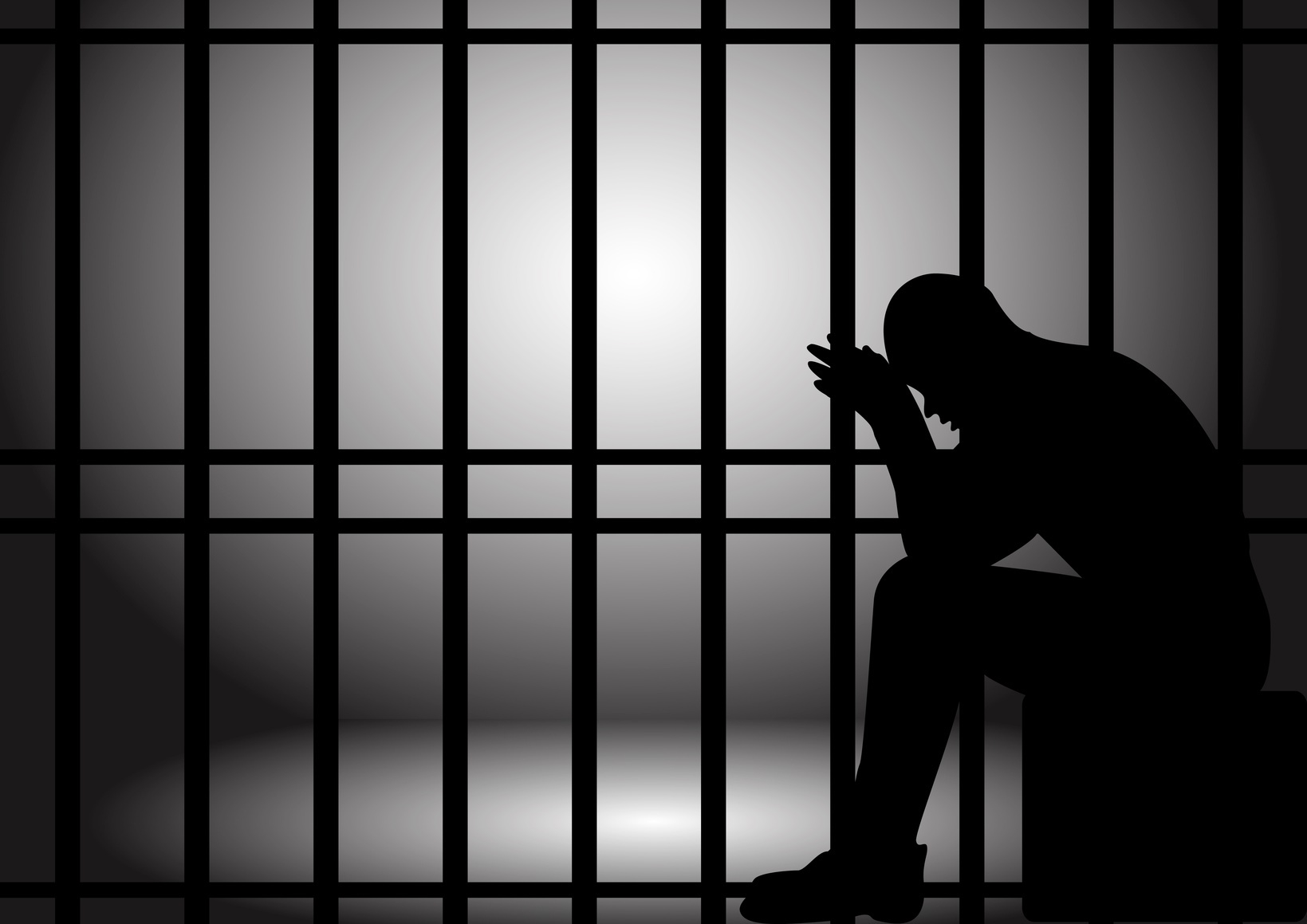
Vector illustration of a man lock up in prisonFor every 100 white women age 25 to 54 not in jail, there are 99 white men. For every 100 black women 25-54 out of jail, the equivalent number of black men is 83. That means that for this age group, more than one out of six black men have disappeared from their communities.

The figures come from a New York Times analysis published this week. I recommend it. There’s plenty more to consider, but as the Times put it:

It is a measure of the deep disparities that continue to afflict black men – disparities being debated after a recent spate of killings by the police – and the gender gap is itself a further cause of social ills, leaving many communities without enough men to be fathers and husbands.

Minor differences between the races – premature death, census undercounting – account for one or two of the 16 “disappeared” black men. The overwhelming disparity is attributable to incarceration.

Demographers have long noted racial discrepancies in crime and sentencing. According to the National Academy of Sciences (NAS), the incarceration rate (people in prison and jail per 100,000 population) was 161 in 1972 and 707 in 2012, a total of 2.23 million people. But the imprisonment rate for blacks was 4.6 times that for whites.

There is little correlation between crime and imprisonment. Rates of violent crime including murder have plummeted over the past 20 years (as I wrote last week), while the imprisoned population has soared. We’ve made a political choice based on fear and separation – that long sentences, mandatory minimums, “three strikes” – will make us safer. They don’t, they just make us harsher (we have 5 percent of the world’s population and 25 percent of its inmates). And if the idea is to lock up people until they’re too old to commit another crime, that’s not an efficient use of either people or money. Our prison budget is $60 billion a year.

For both black and white, the difference between going to prison or not is education, the NAS concluded. In 1972 and 2012, a tiny fraction of 1 percent of whites with at least some college were incarcerated. For blacks, the percentage for both years was about 2 percent. For white high school dropouts, the share behind bars climbed from 2 percent to 13 percent; for black dropouts, the share mushroomed from 6 percent to 35 percent.

It would be scratching the surface to conclude that incarceration exacerbates social, racial and political inquality, jeopardizing our aspirations for a democracy of, by and for the people. Consider the surface scratched. As the Times concluded, 1.5 million of us are not part of the fabric of society. We are truly disappeared.

So when Chief Justice Roberts writes, as he did in a 2007 decision striking down Seattle’s method of mitigating racial disparities in its schools, “The way to stop discrimination on the basis of race is to stop discriminating on the basis of race,” he’s missing something about the country over which he presides.

Posted in civil rights, Prison industry | Tagged , , | 1 Comment

Celebrating “Tax Day” – and perverting it

f1040-1IT IS A NATIONAL DAY OF ACCOUNTS: Tax Day. In bygone years, lots of us had our returns stamped at the post office after dark, taking to the last hour to reaffirm our citizenship. Long before Turbotax, I participated in that late-night trip and found my neighbors in a happy mood; at least we had removed that burden from our back, and in our relief acknowledged a shared duty.

The purpose of the income tax is, of course, to fund our government, to pay the bills for the things that we collectively have demanded that it do. We disagree over the particulars, but we understand that Congress imposes taxes as part of the contract with America. Even as we understand that, Congress chronically shortchanges the bill, handing it off to our children and grandchildren.

Where we pass on the debt incurred in capital investment, that makes sense. Installment payments are rational if the investment is in a highway or education, because the greater returns can be used to pay the debt. It also is wise if the debt is counter-cyclical spending in a depressed economy, when in our fear and scarcity we close our diminished wallets.

Our predilection to have our children pay for our consumption has run in cycles and is long in our character. In June 1782, as victory in the Revolution was imminent, the French diplomat François Barbé-Marbois, with co-author James Madison, then a delegate to the Continental Congress, wrote a letter to a Philadelphia newspaper about the state of the war. In conclusion, Barbé-Marbois extolled the virtues of his adopted people:

DOI+July+8th+PrintingI am now more proud of the title of American than I have ever been: the enemy have, without intermission, represented us as a timid and dastardly people, without faith and without honour: they are now undeceived at their own expence. But there is one point in which our national honour has too long suffered: we have sufficient firmness to abandon our houses and our habitations to an incendiary foe; we have seen without terror our houses and our farms in flames; we have seen our effects, our horses and our cattle swept away, and our sentiments have remained unshaken; we have received with contempt overtures of peace which would have covered us with shame; we have suffered all the calamities and wants which afflict exiled citizens, obliged to seek an asylum at a great distance from their own country. Our wives have shewn the same firmness of soul, and sometimes their firmness and patriotism have invigorated our own. We have shed our blood in the glorious cause in which we are engaged; we are ready to shed the last drop in its defence. Nothing is above our courage, except only (with shame I speak it) the courage to TAX ourselves.

Our lack of fiscal courage was okay when we were pushing frontiers, expanding markets, raising our productivity. But resistance to taxation in recent decades has coincided with a destructive resistance to government itself, as if government were not us, as if we did not create the context for its acts in our name.

HR 1105IN HONOR OF TAX DAY 2015, the House of Representatives will pass a bill, on a party-line vote, that would eliminate the estate tax (I’ve seen this movie many times, so I’m not waiting for the final scene before posting). The 40-percent tax generally applies to the gross value of a decedent’s estate, except that the first $5.43 million – or twice that in the case of married couples – is exempt. In other words, the beneficiaries of the House’s largess are multimillionaires, perhaps 5,500 families a year. It would save the heirs of those fortunes $269 billion over 10 years, or $4.9 million per decedent. Who gets to make up the difference? We do.

The estate tax is an idea as old as the republic, a mechanism to level massive fortunes and reduce the possibility of a permanent aristocracy. As recently as 2001, the $5 million exemption was $675,000. After a temporary elimination of the tax enacted as a part of President Bush’s 2001 tax cuts, President Obama two years ago agreed to the current rate and indexed exemption. That’s not generous enough for House Republicans.

The House also will pass a “Taxpayer Bill of Rights” that includes a right to “quality service” from the IRS. The press release of the House majority leader was headlined: “House Will Protect Taxpayers and Rein in the IRS.” But as the IRS Taxpayer Advocate reported to Congress last year, and as newspapers across the country have reported this month, Congress has pretty well “reined in” the service.

Nina Olson, who has been the IRS’s independent taxpayer advocate since 2001, told Congress last year that that the agency’s inflation-adjusted budget has declined 17 percent since 2010, while the number of taxpayers and complexity of the code has grown (not news to Congress – it cut the budget and increased the complexity). What’s that meant for taxpayers needing assistance?

  • 36 percent of phone calls went unanswered
  • Half of letters from taxpayers were not handled timely
  • IRS walk-in offices prepared “virtually zero” returns
  • Face-to-face outreach and education, intended to help 126 million individuals understand and comply with tax obligations, has “nearly disappeared”

The approach of House Republicans is, “We don’t like this tax (on millionaires), so we’ll get rid of it.” But we should not set tax policy without context. The question is, “What is the fairest means of financing the government we have and want?” We can disagree on “fairness,” and we do. That’s where the debate should start, not on whether to give heirs  tax-free, multi-million-dollar windfalls.

Posted in Tax | Tagged , , , | 1 Comment

Reassessing the thin blue line

walter-scott-shooting-600If the sacrifices of Michael Brown, Walter Scott and others to come wake us to the nature of the thin blue line that the economic oligarchy has established to keep us gasping in the context of fear and chaos, then their entire edifice could begin to crumble.

We can choose a meaning for their lives and deaths: a wake-up call from the fear that dominates our political culture. Why is a black man 21 times more likely to be shot by a cop than white man? Why is it “normal” for a mother of a two-year-old to take her loaded handgun on a Christmas shopping trip? What is the feeling behind needing to own a weapon whose purpose is to kill people? (I’m not talking about hunting rifles.)

In Errol Morris’s 1988 documentary about a trial (and wrongful conviction) for the murder of a Dallas police officer, the judge recounts the prosecutor’s argument that the “thin blue line” (cops) “separate[s] the public from anarchy.” We can be safe if we build a thick enough line. It is a belief that We the People have long held.

What industries profit from that belief? Start small and expand:

  • Home security systems and contractors
  • Car alarm makers
  • Developers (and owners) of gated communities
  • Private security services
  • Firearms manufacturers
  • The prison industry – construction firms, maintenance contractors (food, uniforms, trainers, private employers), for-profit prison owners
  • TSA contractors
  • Defense contractors

That’s a fair portion of our GDP dedicated to “keeping us safe,” as politicians describe it. Our fear, heightened by 9/11, has us in the grip of authority. But it isn’t enough that the white hats are watching out for us, we need private security too.

835323_e364dcc1c6Lately, however, as a part of the surveillance state, we’re seeing holes in our security blanket. We are all journalists, camera-ready to capture a different reality. At Abu Ghraib our soldiers loosened our certainty. Bystanders videoed multiple angles of the choking of Eric Garner on Staten Island. A stationary video shows Tamir Rice falling in a Cleveland park. This month another witness with a camera captured a North Charleston policeman executing and then attempting to frame Walter Scott. Just about every day since, the media publish a story, often with video, providing evidence of police brutality.

Cops are rarely indicted, as we have heard since the Brown and Garner grand juries dissolved. We give the police the benefit of the doubt. Or we did.

In a Washington Post column, photo journalist and war correspondent Ron Haviv asks: “Does the volume of imagery take us to another level of numbness or fatigue, or will it increase the urgency to respond to what we see?”

I sense a growing urgency. Protest in Ferguson led to a federal investigation, the resignation of high-ranking civilian and police officials, and after last week’s elections a more colorful city council. Video and the experience of Ferguson led North Charleston officials to charge Officer Michael Slager (but not his partner, who appeared to be an accessory to evidence tampering).

The bigger question is whether all the evidence of misconduct will shift our culture’s view of the police: that they are no less likely to lie and distort than anyone else who has something at stake in a courtroom, and with their badge perhaps more at stake. If police officers say they fear for their lives as the routine justification for firing their weapons, as Ferguson Officer Darren Wilson testified, are they in the wrong line of work?

What if we reevaluate the nature of the thin blue line? What if we decided that the line is about keeping certain populations in check? What if we saw that we all are part of the chaos we have created? What if we understood that we are inseparable, caught in an inescapable network of mutuality, that people are people and that in the moment any one of us, even a cop, may lose perspective and act beyond comprehension?

A different question. What if we become aware that, media distortions aside, the rate of violent crime has fallen sharply over 20 years? That the rate of death from crimes involving firearms has fallen by half, and the rate of non-fatal violent crime is down by two-thirds?

Does our fear create chaos, or does the perceived chaos instill fear? If the answer is the former, then what’s the point of all that security spending? And if we decide, “No point,” then what do we do about that edifice?

images

Posted in Prison industry | Tagged , , , , , , , | 1 Comment