What’s next: equal rights after Indiana

1times1a

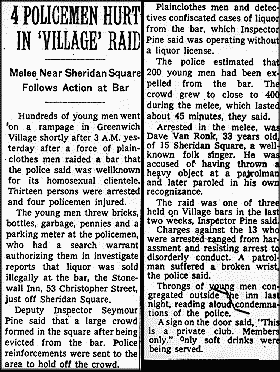
New York Times coverage of the Stonewall riots, June 1969

Last week we discovered how far we have come in recognizing the human rights of people who do not identify with sexual norms.

As a matter of law, LGBT rights have been ping-ponging between federal and state legislatures and courts for three decades, since the Supreme Court’s 1986 decision in Bowers v. Hardwick, which upheld Georgia’s homosexual sodomy law. Other rights-expanding court cases followed, with Congress and legislatures resisting equal rights, especially after the Supremes reversed Bowers in two cases in 1996 and 2003. The following election year, voters of 13 states amended their constitutions to ban same-sex marriage. Thirteen more states had passed similar amendments by 2008, bringing the total to 30. At the time, federal law barred federal recognition of extant same-sex marriages, and the U.S. military was still operating under “don’t-ask-don’t-tell.”

Late this month the Supreme Court will hear arguments in a consolidated case, Obergefell v. Hodges, that virtually all observers expect to result in the right of same-sex marriage throughout the United States. Propelled by the logic of the high court’s invalidation in 2013 of the 1996 Defense of Marriage Act, lower court decisions and state laws have brought gay marriage to 37 states.

Eleven days ago, Indiana enacted a law granting individuals and corporations a defense against a civil action for discrimination if their “exercise of religion” had been “substantially burdened.” After six days of nationwide outcry – predictable had Governor Mike Pence been paying attention – Pence signed an amendment that denied that same defense “to a civil action or criminal prosecution for refusal by a provider to offer or provide services, facilities, use of public accommodations, goods, employment, or housing to any member or members of the general public on the basis of . . . sex, sexual orientation, [or] gender identity . . . .” What was intended as a bar to equal protection became a leap ahead for the Indiana Code, and it slammed the door on discriminatory proposals in other states.

Because the Republican Party grants disproportionate influence to presidential primaries in Iowa and South Carolina, candidates and so-called religious conservatives will continue their battle based on belief, fear and exclusion, even as the rest of the country moves on. Except for that diminishing exchange – and the Supreme Court’s Obergefell decision – the fight for LGBT equality is nearly done. What made it successful? Several factors, I suggest.

How we have leaped

First, gays and lesbians are indistinguishable from everyone else. “Don’t-ask,” to the extent it worked (and it didn’t), seemed reasonable because it relied on a belief that homosexuality is an immoral “lifestyle” and an affront to societal norms. The majority worked off a construct that made “choice” discrimination okay. But once we found out that we had a gay relative or neighbor or colleague, we began to question our construct.

Second, the gay movement (such as it is) corralled its economic might. It understood the political process. It mounted litigation coast to coast. It drew effective lawyers, like the duo of David Boies and Ted Olson, adversaries in Bush v. Gore, who litigated California’s Proposition 8 before the high court.

Third, it took advantage of a historic era of expansion of legal equality. With an African-American in the White House, Americans signaled a willingness to question confining belief. To think anew.

What’s next? Plenty.

The Bill of Rights as a blueprint for the democratic process remains to be fulfilled. The Ninth Amendment leaves room for rights unenumerated in the Constitution, such as the right to vote. But voting rights is in retreat in many states, encouraged by the Supreme Court’s 2013 invalidation of a key enforcement mechanism of the Voting Rights Act. The Supremes last month let stand Wisconsin’s voter ID law, though other voter ID cases remain in the pipeline, among them Veasey v. Perry, in which a federal trial court struck down a Texas statute last fall.

The broad struggle for women’s rights drags on. Jimmy Carter, in a column explaining his decision six years ago to sever ties with the Southern Baptist Convention, surveyed types of discrimination against women all over the world – the types Americans abhor – like denial of driving or getting educated or genital mutilation. Carter wrote, “The same discriminatory thinking lies behind the continuing gender gap in pay and why there are still so few women in office in the West.”

i_am_a_man

Undated 1960s civil rights protester and 2014 in Ferguson

Fear of black and brown remains in our country’s DNA, as reflected in our exercise of the police and judicial powers that the Fifth, Sixth and Eighth amendments were designed to limit. Despite the Fifth’s guarantee of life, liberty and property, young black men are 21 times more likely than young whites to be killed by police. Whether one receives Sixth’s guarantees of an impartial jury and effective counsel correlates to wealth and race. Of the 1400 persons executed since 1976, 42 percent were black or brown. Our interpretation of the Eighth’s proscription of cruel and unusual punishment has 2.3 million Americans incarcerated and 6.9 million under “correctional supervision” – prison, parole or probation, many for non-violent convictions or for no conviction at all.

“No country, however rich, can afford the waste of its human resources,” Franklin Roosevelt told us. In some respects, we are casting aside belief in favor of reason in the uneven march toward a more perfect union. We have many roads yet to travel.

Posted in Bill of Rights | Tagged , , , , , | 1 Comment

Byway for a visionary country

100 the shotGoing-to-the-Sun is an engineering marvel, a highway scraped out of snow-capped mountains that lifts travelers over Logan Pass in Glacier National Park. That a park would be named after a chunk of ice in far-off Montana long fascinated me. In 2007 I took my first extended bicycle trip, the climax of which was a ride with two new friends (including photographer Harry Campbell) up that highway starting at dawn, from Avalanche campground to Logan. Those three hours of slow, steady pedaling (and the half-hour return without turning the crank) transformed my life: I identified as a cyclist, a definition that would shift the way I look at the world.

Over the following years, I traveled across the archipelago of state and national parks – from Lake Champlain to the Cumberland Valley, along the Lewis and Clark Trail from the Pacific to Yellowstone to Grand Teton, from the Great Salt Lake to Rocky Mountain, and most frequently crisscrossing the Appalachians from Pennsylvania to Mt. Rogers in southern Virginia. (I describe some of those sojourns on an old blog, Ruminations on Rambling.)

My trips were possible because Congress and Interior Department bureaucrats executed a vision granting Americans access to wilderness areas across the country. The Park Service, created 99 years ago, now includes 407 sites and 22,000 employees. More than 221,000 volunteers serve 293 million annual visitors.

Going-to-the-Sun, for example, is 50 miles long, completed in 1933 after 12 years of construction. It’s a heritage bequeathed to my generation thanks to the imagination, tenacity and money of our forebears.

Somehow over the last three decades, we’ve lost the commitment to maintaining that heritage, deciding without deciding that the parks aren’t worth the effort required to pass them to our children. The Park Service needs $11.3 billion in maintenance, $6 billion for roads alone.

Perhaps much of that backlog is unnecessary. Maybe Congress has created too many parks, monuments, and historic areas of dubious significance. Or the Park Service has skewed priorities and practices.

IMG_2943Among the facilities in the Park Service domain is Memorial Bridge, between Arlington Cemetery and Washington. The nation’s most majestic federal bridge connects the Lincoln Memorial with the estate of Robert E. Lee. John F. Kennedy’s funeral procession rolled across it. The Marine Corps Marathon runs over it. Thousands of cars commute on it. And it’s deteriorating, needing a couple hundred million dollars to repair corrosion and replace a 20-foot section of guardrail that was destroyed when a car crashed through it into the Potomac 25 months ago.

Commitment to repairing that bridge and 1400 others begins in Congress. Last week the House and Senate passed their annual budget resolutions. The documents are, as I’ve reported for three decades, the part of the spending process in which committees of jurisdiction receive instructions for drafting the bills that fund all parts of the government. Both versions, which Congress is to reconcile into a single resolution in April, call for slashing the part of the budget that constitutes everything that government does within our borders – maintain parks, build highways and airports, fund basic research, inspect food, monitor water, operate courts and prisons, run the IRS, pay government salaries. Total federal spending, now about $3.8 trillion a year, would be reduced by a half-trillion per year for 10 years, compared to current law.

The budget process is an inside game, a snooze except to those who get the lingo and procedure and numbers that represent choices. But the federal budget, like all budgets, represents a vision. It speaks to what moves our leaders and by extension what moves us.

Without detailing the choices, what this year’s resolutions say is: We choose not to fix Memorial Bridge. We choose to be penny-wise. We are broke.

That’s silly. We inhabit the richest nation in history.

The resolutions are driven by the idea of eliminating the budget deficit in 10 years, without raising taxes or adjusting Social Security revenues or benefits, and while increasing defense spending. The long-term driver of the rising cost of government – medical costs for the elderly and the poor – is unaddressed except to slough them off to the states and individuals.

What has us living in such scarcity? What has us substituting a number for a vision? What has Congress saying “not a penny more” rather than painting a picture of our future and enrolling us in it? Or explaining: Our plan is a much smaller government, and here are the things it will no longer do. This budget resolution does neither.

Instead Congress is setting an arbitrary goal – eliminate the deficit (a bit under $600 billion) solely by cutting or shifting spending – without spelling out the consequences of that choice.

When I reported from the Capitol, the leaders told the rank-and-file: Vote for this, we’ll fix your complaint down the line. They would somehow mollify and make the necessary deals with the White House.

For four years, the end game has involved the chaos of stalemate and shutdown – and that was with divided control of Congress. This year, with Republicans in charge of both chambers (and if they can overcome internal contradictions), their adversary will be the Democratic president, who will not sign bills that cut spending $5 trillion. So the exercise amounts to a series of press releases.

The problem is, the budget-writing process is backward. Congress is saying: Here’s the number, later we determine the consequences. It should start: Determine what we want to create; estimate the cost; go get the money.

That’s how businesses work. Start-ups find investors: Visionaries decide what they want to build and what it will cost, and then they enroll venture capitalists or go public. This is how households work, too. Families have a vision of what they want – houses, cars, college educations, and they either work more (and forgo other things) or go to the bank, or both. Successful companies, like successful families, are driven by their vision, not by self-imposed limitations.

Yet our Congress is without vision, operating without clarity on the consequences of its choices. One of them is evident. Memorial Bridge has had a hole in it for two years.

Posted in Uncategorized | Tagged , , | Comments Off on Byway for a visionary country

Belief as limitation, on campus and off

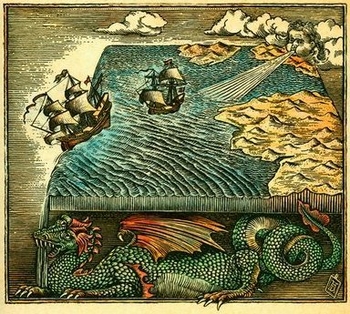
rsz_world-flat_5884When I am not thinking about the next blog, I staff workshops that support people in discovering that all of their experience is narrowed by their beliefs. The simplest example of this phenomena is that a little while ago, we believed that the earth was flat and reduced our range of choices accordingly: When sailing, stick close to shore, else you may fall off. Then explorers brought forth a shift in consciousness, and the known world expanded.

Recently I wrote about state legislators who are trying to narrow high school students’ study of history with which they disagree, on the theory that the kids would get the wrong idea about its “truth.” These efforts are an easy target for “liberals” because of the slant, which originated in a Republican National Committee resolution condemning a revised AP history guidance document as “a radically revisionist view of American history.”

President Obama referred to the controversy over “American exceptionalism” in his speech at Selma this month.

What greater form of patriotism is there than the belief that America is not yet finished, that we are strong enough to be self-critical, that each successive generation can look upon our imperfections and decide that it is in our power to remake this nation to more closely align with our highest ideals?

The objective of AP history, other than the college credit, is to learn to think critically. The follow-on instrument for inquiry is the liberal-arts college, a manifestation of our belief in the potential to advance knowledge. Yet like any institution, it has its blind spots, one of which conservatives dub “political correctness.” And as commencement season nears, we can expect students on some campuses will protest this or that dignitary invited to address the graduating class. The seniors, in several high-profile instances, will object to a speaker whose views are anathema to their own, so dogmatic have they become.

selmaCollege administrators, some of whom have become bureaucrats weighing competing interests (students, parents, faculty, alumni, politicians, echo-chamber media), are losing their wits and forgetting their purpose, at least as foreseen by Thomas Jefferson when he founded the University of Virginia:

This institution will be based on the illimitable freedom of the human mind. For here we are not afraid to follow truth wherever it may lead, nor to tolerate any error so long as reason is left free to combat it.

I like the first sentence: the illimitable freedom of the human mind. Problem is, many of us interpret “truth” to be absolute, when it is nothing more than our own interpretation. Yet we act as if another’s truth offends our own.

In a New York Times column on the fear that is limiting discussion on college campuses, Judith Shulevitz quotes a student, “I was feeling bombarded by a lot of viewpoints that really go against my dearly and closely held beliefs.” The gist of Shulevitz’s reporting is that colleges have become dedicated to creating “safe space,” where students are protected in their prejudices, as if contrary ideas by themselves would trigger old trauma.

Well, having one’s beliefs challenged is the requisite of education. Stress – confronting and then surpassing our limitations – is what life is about. We strive to break through convention, unless we hold ourselves back because of some past trauma that inhibits our reach.

As a volunteer staff in multi-day workshops held by Gratitude Training, I aim to establish “safe space,” not so that participants are protected in their beliefs but so that they confront them, and realize that those beliefs – whether light or dark, enjoyable or traumatic – are of their own making, an interpretation of experience that has them constrained from taking action on their dreams.

At Selma, the marchers for voting rights and their forebears had experienced centuries of repression. Instead of hiding out in Brown Chapel, they marched into a police phalanx and three weeks later, on their third try, reached Montgomery.

College campuses are fraught with no such danger. Neither are history lessons.

Posted in education, Voting Rights Act | Tagged , , , , , | 1 Comment

A tale of two tuition bills

IMG_1605Recently I tossed decades of canceled paper checks, but one I kept: $424 for tuition and fees at the University of Virginia for fall 1978, my sophomore year. If college costs reflected CPI, this year Mr. Jefferson’s Academical Village would cost $1,552 per semester, as a dollar then is worth 36 cents today. Instead tuition now is $6,938/semester.

That check is on my home-office posterboard, along with the bill for my daughter’s recent tuition bill at a private university. Every parent with a college-age kid knows that the sticker price of private colleges is north of $50,000 per year, less scholarships for some. Financing college is an insurmountable burden for many.

Many issues are at play in these rising costs. One is the limited productivity gain for education: A teacher still stands in front of a given number of students to deliver a lecture/discussion. In the labor/capital relationship, the price of skilled labor has risen, and the price of money and capital-intensive goods has fallen sharply. (A color TV costs less today than it did a decade or four ago.) Critics of universities like to point their profligacy: fancy facilities, out-of-control football programs, superfluous research with little value for students.

The factor that interests me has little to do with economics or budgetary extravagance: it’s about choice. As costs have gone up, state government support to public colleges has fallen.

According to the American Council on Education (school presidents), inflation-adjusted tuition has surged about 250 percent at state four-year schools since 1980. The states in aggregate provided 60 percent of college budgets in 1975, and 34 percent in 2010. By another measure, state fiscal support in 2011 was equal to $6.30 per $1,000 of state personal income – down from $10.58 in 1976.

UVAIn Virginia, state support now amounts to less than 6 percent of my alma mater’s budget. (In what sense is that a state school?) In the past month, governors in Louisiana, Wisconsin and Illinois, among others, have proposed slashing state aid to higher education by hundreds of millions of dollars. During the Great Recession, between 2007–08 and 2012–13, California’s appropriations to its two public systems declined 30 percent, and per-student subsidies fell by more than half.

Another measure comes from the State Higher Education Executive Officers (the association of state boards of postsecondary education). In 1988 states provided $75 billion (in 2013 dollars) to post-secondary schools. In 2013 they provided $78 billion. That’s a 5 percent increase – despite a 56 percent increase in enrollment. Students’ net tuition payments over the same period rose from $19 billion to $62 billion, in 2013 dollars.

Much of that tuition is paid with borrowed money. Seven in 10 graduates in 2013 held debt, and that debt averaged $28,000, according to the non-profit Institute for College Access & Success. The New York Fed reported last month that total student debt nationwide stands at $2 trillion and that delinquencies (debt that has not had a payment made in 90+ days) are at 11.3% of outstanding debt.

The national price of college debt

The effect of starting one’s career with that kinds of debt?

Those who cannot or will not finance college by borrowing have limited options. Studies have proliferated about the hollowing out of the working class because of the loss over the same period of good-paying, non-college jobs to automation and offshore manufacturing. Family income and marriage rates have declined; out-of-wedlock births have increased. The difference a college education makes is incalculable. Almost.

We know that higher education benefits the individual (higher salary), private industry (lower training costs), government (higher income tax revenue), and society (higher standard of living). College-educated citizens have healthier lifestyles and are less likely to smoke or be obese. As parents they devote more time and energy to their children’s development. Higher education increases social mobility at a time when economic class divisions are sclerotic.

Higher education is also an investment in democracy. Half the population doesn’t vote – typically those who are less educated, have less income, and depend more on government social support programs. The reduction in public funding reflects a populace unwilling to shoulder the costs of educating its children.

As Georgetown University’s Center on Education and the Workforce reported in a 2011 study, the demand for college-educated workers – particularly those with backgrounds in STEM (science/technology/engineering/math) – has outpaced supply. The talent shortage limits the economic gains the nation would achieve as a whole. And it exacerbates the pay differential – income inequality – because employers must pay a premium for better educated workers.

In the 1960s young Americans were by far the best educated generation the world over. Today 42 percent of Americans age 25 to 34 have college degrees, way behind Korea and Canada, where more than half of the same age cohort have post-secondary credentials. According to the OECD:

The U.S. is the only country where attainment levels among those just entering the labor market (25-34 year-olds) do not exceed those about to leave the labor market (55-64 year-olds). This is why international comparisons look so different among younger age groups. Among 25-34 year-olds, the U.S. ranks 15th among 34 OECD countries in [post-secondary] attainment.

What has led us the precipice of a kind of national suicide?

Consequences of taxpayer choice

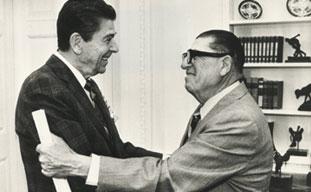
reagan_100

Ronald Reagan with Proposition 13 author Howard Jarvis

As with many social and economic indicators, we began contracting in about 1980. In 1978 California voters approved Proposition 13, amending the state constitution to limit property tax increases. That began a taxpayer revolt that other states imitated and that Ronald Reagan led as president. The Republican Party has advocated tax reductions and minimal social services ever since, and it now holds more seats in the U.S. House and state legislatures than at any time since the 1920s.

Thus it’s clear, at least among a majority who vote, that taxpayer-supported higher education is not a priority in many states. Our hostility to supporting higher education, through taxation, is undermining the resources we need to compete in the world and exacerbating inequality at home. (Though we do seem passionate about college football.)

Summarized Anthony P. Carnevale, co-author of the Georgetown report, “In recession and recovery, we remain fixated on the high school jobs that are lost and not coming back. We are hurtling into a future dominated by college-level jobs unprepared.”

Put another way, we have focused on what we don’t want – to pay taxes – rather than what we do want, which is, perhaps, to grow, enjoy abundance, support our children, and advance the nation that was bequeathed to us.

It’s a choice.

Posted in Uncategorized | Tagged , , | 2 Comments

Compulsory voting: Would it fix what ails us?

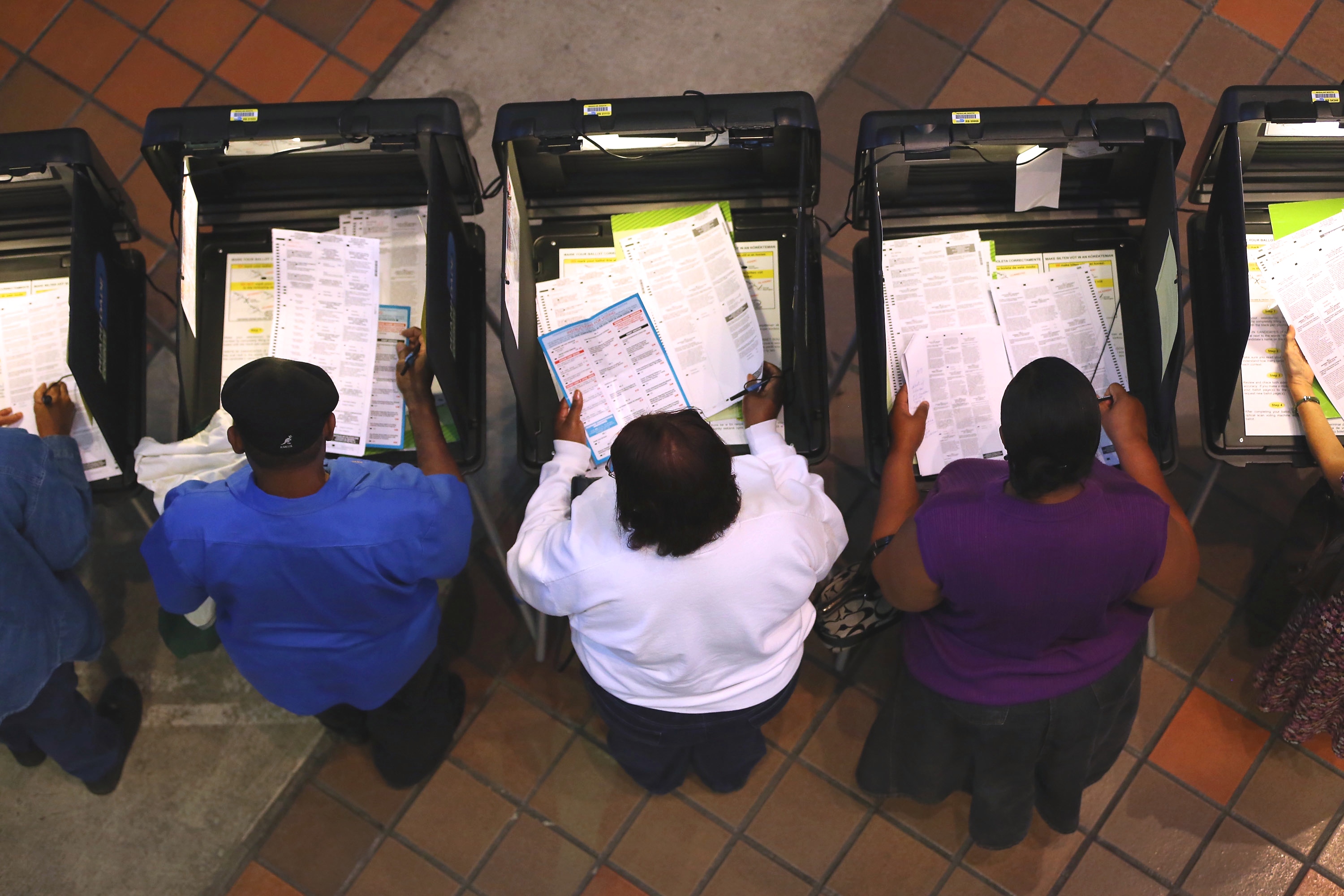
Early Voting Starts In Florida

With commemorations of Selma and the taking stock of how far we have come in extending voting rights, a question occurs:

What would American democracy look like if voting were a requirement of citizenship?

First, consider what American democracy looks like without it. In the last presidential contest, 59 percent of the nation’s 222 million eligible voters turned out. In the 2014 midterms, 36 percent of 227 million voted, and turnout was no more than 30 percent in nine states.

Why is turnout so low?

Perhaps citizens deny themselves the opportunity because they think:

  • Politicians are owned by special interests
  • There’s little difference between the two parties
  • Officials are corrupt; the system is rigged
  • Citizens are powerless to effect change
  • About politics not at all and feel no connection to government

Those “reasons” are beliefs, not factual. But some states discourage voting, by law or practice:

  • State legislatures gerrymander state and U.S. House districts to maximize political advantage, in turn depressing turnout (in a district or state dominated by one party, any one vote counts less toward the outcome, no matter one’s vote)
  • Voting is cumbersome – a two-step process of registration, for which the deadline typically is weeks before the election, followed by voting
  • Since 2010 (as I wrote recently), many states have restricted registration and voting with burdensome ID requirements and reduced early-voting periods

How would compulsory voting change these dynamics? No one knows. A counter-factual is difficult to prove. But I have a few thoughts.

First, voters would be less inclined to live out of a belief that their vote doesn’t matter. If voting were required, and one voted, it would be harder to believe that the act is meaningless.

Second, state legislatures would be obliged to reduce barriers to voting. For example, in an electronic era, closing voter registration weeks before an election is anachronistic. Some states already have same-day registration. Election days, which are set by law not by the Constitution, could be moved to a weekend or made a holiday (or shifted to a month not designed to coincide with courthouse market day after harvest season). And the suppression resulting from discriminatory ID requirements would make no sense.

More significantly, compulsory voting might shift the rationale of campaign strategies, which are now built on two goals: identifying and “energizing the base,” and depressing opposition turnout with negative ads and other means. “The other guy is a liar” is not an ad designed to attract support but rather to discourage voters antipathetic to its sponsor.

If your email address has found its way into a political advocacy group – anything from MoveOn.org to the NRA – the message is the same: “The sky will fall if you don’t help us stop the latest outrage by the other side. (And send money.)” Fear is a more effective motivator than confidence.

Compulsory voting might steer both sides toward the center, which is presumably where the non-voters, the unmotivated, now live. Would not a candidate trying to appeal to the unenthusiastic aim for the center, assuming that the passionate already vote?

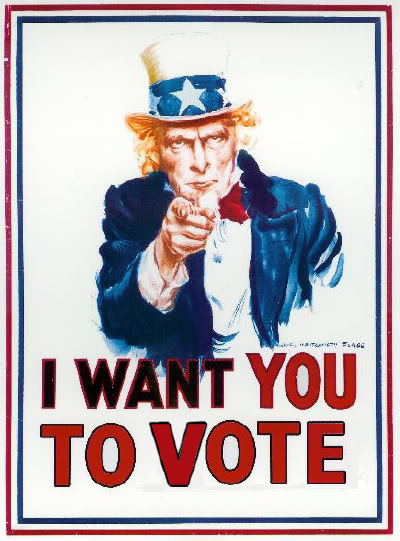
Iwantyou2voteThe money dance

Compulsory voting might dampen the influence of big-money contributors, evident in the magnates commanding Republican presidential hopefuls to genuflect before them in recent weeks, and in President Obama’s appearances at dinners for $35,000 a plate. Most of that money buys ads, whose only purpose is to somehow convince voters to take maybe an hour (except in places like Cleveland and Florida) out of a year to go stand in a line – or not to bother.

Of course, partisans would have to pass that bill mandating voting – and they would look to see what kind of advantage or disadvantage would come with the shift. As the Republican Party has spent so much energy in recent years on restricting voting, one would assume they’ve done the calculus. But there are other scenarios.

It could be argued that compulsory voting would help the GOP in ways not now recognized. The party, in tilting back toward the center, might establish a working majority, as opposed to the oppositional status that demographics and philosophy seem to guarantee it for the foreseeable future (as if the future were foreseeable).

For example, in Virginia, where Republican candidates have lost statewide elections in five of the last six years but thanks to demographics and gerrymandering have a lock on the state legislature, compulsory voting might shift the party from focusing on its base to assembling a working majority that could win U.S. Senate seats and the governors mansion.

Or compulsory voting could lead to reunification of the Democrats’ populist and centrist elements as they seek the 64 percent who didn’t show up last November.

Among the duties of citizenship

Some may argue that compulsory voting is an infringement on liberty – not voting as a protest. But we have other obligations of citizenship we accept: paying taxes, sending our children to school, serving on juries (the pools derived from voter registration roles). After all, our representatives created these legal obligations.

Isn’t the main point that “governments are instituted among Men, deriving their just powers from the consent of the governed”? And that “the nation shall have a new birth of freedom, and that government of the people, by the people, for the people, shall not perish from the earth”? What is our freedom if not consented to, and affirmed, by us – all of us?

Twenty-six countries require their citizens to vote, including most in South America, Mexico, a few in Africa and Europe, Egypt and Turkey. The nation most like America, a largely immigrant nation with a democratic tradition rooted in the English common law, is Australia. It’s had compulsory voting since 1924. Surveys put the law’s approval above 70 percent (responding to surveys is no doubt voluntary). Its effect on election outcomes is debated – again, proving a counterfactual is challenging.

Given the public’s disdain for our government and the polarization among our legislators, we might try something different. Compulsory voting could hardly produce a worse outcome, and it might create something better.

Posted in Voting | Tagged , , , , | Comments Off on Compulsory voting: Would it fix what ails us?

Three speeches and a bump on the road to a more perfect union

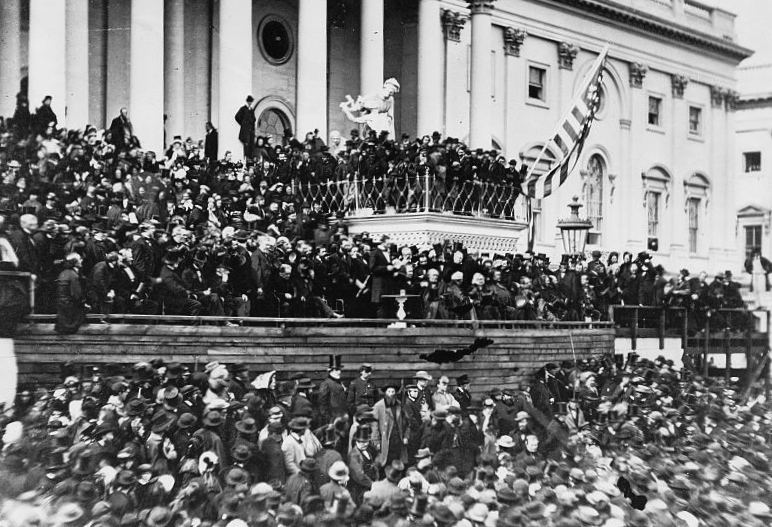
Lincoln second

U.S. Capitol, March 4, 1865

In our journey toward a more perfect union, we have witnessed cycles of history since Abraham Lincoln delivered the greatest speech in American history 150 years ago. Two other speeches, 50 years ago this month, complete a cycle of that journey. In our time, we are in the midst of one, incomplete.

On March 4, 1865, Union forces were engaged in mop-up operations from Virginia to South Carolina. After four years, the commander-in-chief was expected to celebrate the Union’s imminent triumph over the rebellion. But at his second inauguration, the president referred only in passing to the progress on the battlefield (“it is, I trust, reasonably satisfactory and encouraging to all”). Instead he offered a rumination, with a reference to David’s 19th Psalm, on whether the war represented atonement for the Constitution’s original sin:

Yet, if God wills that it continue until all the wealth piled by the bondsman’s two hundred and fifty years of unrequited toil shall be sunk, and until every drop of blood drawn with the lash shall be paid by another drawn with the sword, as was said three thousand years ago, so still it must be said “the judgments of the Lord are true and righteous altogether.”

Five weeks before, Congress had passed the 13th Amendment prohibiting slavery. Five years hence, the 15th Amendment would extend the right to vote without regard to “race, color or previous condition of servitude” and give Congress the power to enforce it.

One hundred years later, in the winter of 1965, voting rights organizers targeted Selma for a nonviolent registration campaign. The nation again turned toward Alabama after police shot and killed an unarmed black man, Jimmie Lee Jackson, in a diner; sheriff’s deputies beat marchers at the Edmund Pettus Bridge; and white supremacists murdered a white minister, James Reeb.

‘And we shall overcome’

Six days after Reeb’s death, on March 15, Lyndon Johnson addressed a joint session of Congress. “I speak tonight for the dignity of man and the destiny of democracy,” the president began.

“Our fathers believed that if this noble view of the rights of man was to flourish, it must be rooted in democracy. The most basic right of all was the right to choose your own leaders. The history of this country, in large measure, is the history of the expansion of that right to all of our people . . .

“Every American citizen must have an equal right to vote. There is no reason which can excuse the denial of that right. There is no duty which weighs more heavily on us than the duty we have to ensure that right.”

Martin_Luther_King_Jr._and_Lyndon_Johnson_2-600x400

Lyndon Baines Johnson Library and Museum

After outlining what five months later became the first law enforcing the 15th Amendment, Johnson said its enactment would not end the battle.

“What happened in Selma is part of a far larger movement which reaches into every section and state of America. It is the effort of American Negroes to secure for themselves the full blessings of American life. Their cause must be our cause too. Because it is not just Negroes, but really it is all of us, who must overcome the crippling legacy of bigotry and injustice.

“And we shall overcome.”

Like Lincoln, Johnson closed with an interpretation of divine will. “God will not favor everything that we do. It is rather our duty to divine His will. But I cannot help believing that He truly understands and that He really favors the undertaking that we begin here tonight.”

Ten days later, 25,000 people completed the march from Selma first attempted on March 7. In front of the Alabama State House, Martin Luther King, Jr., said, “I stand before you this afternoon with the conviction that segregation is on its deathbed in Alabama, and the only thing uncertain about it is how costly the segregationists and [Governor] Wallace will make the funeral . . .

“Let us march on ballot boxes until we send to our city councils, state legislatures, and the United States Congress men who will not fear to do justly, love mercy, and walk humbly with thy God. Let us march on ballot boxes until brotherhood becomes more than a meaningless word in an opening prayer, but the order of the day on every legislative agenda.”

The trinity of Johnson’s civil rights laws – the 1964 Civil Rights Act, the 1965 Voting Rights Act, and the 1965 Immigration and Nationality Act – marked a peak of government action to manifest the ideals of the Declaration. Forty-three years after that, the American people advanced those ideals at the ballot box, electing an African-American president.

But since 2010, we have experienced backlash, as 22 states have restricted voting, mostly by reducing early voting periods or requiring voter ID and/or proof of citizenship (the Supreme Court struck down proof of citizenship). The purpose, supporters claimed, was to prevent fraud. They have offered little evidence but often conflated their allegations with illegal immigration.

The eyes of Texas

In a series of unexplained orders last fall, the Supreme Court weaved all over precedent in blocking some restrictions and allowing others to stand for the 2014 elections. In one, Veasey v. Perry, the high court affirmed the Fifth Circuit’s stay of a federal district court injunction of a Texas law, SB 14, thus allowing elections under the nation’s most restrictive voter ID law.

District Court Judge Nelva Gonzales Ramos had found that:

  • SB 14 was enacted with a racially discriminatory purpose in violation of the Voting Rights Act
  • It effectively imposed an unconstitutional poll tax because of the limited types of qualifying identification
  • Texas did not publicize the new requirements
  • The state produced no evidence of widespread voter fraud, and
  • The law would potentially deny the franchise to 600,000 citizens
Nelva-Gonzales-Ramos

Ramos at her confirmation hearing before the Senate Judiciary Committee, May 2011

Judge Ramos’s 147-page opinion outlines the history of a legislature denying government of the people, by the people and for the people since the 19th century. As Justice Ruth Bader Ginsberg wrote in dissent of the Supreme Court’s stay:

“The District Court noted particularly plaintiffs’ evidence – largely unchallenged by Texas – regarding the State’s long history of official discrimination in voting, the statewide existence of racially polarized voting, the incidence of overtly racial political campaigns, the disproportionate lack of minority elected officials, and the failure of elected officials to respond to the concerns of minority voters.”

Neither the Supreme Court nor the Fifth Circuit ruled on the merits of Texas’ appeal. The case is pending. Meanwhile, Texans’ registration and voting rank close to last among the states. Turnout rates – voting age population to voters registered, and registered to voting – fell in 2014, to 34 percent and 25 percent, respectively.

How long?

In Montgomery, Dr. King concluded, “We must come to see that the end we seek is a society at peace with itself, a society that can live with its conscience. And that will be a day not of the white man, not of the black man. That will be the day of man as man.”

He rejoined, “How long? Not long, because no lie can live forever.

“How long? Not long, because you shall reap what you sow . . .

“How long? Not long, because the arc of the moral universe is long, but it bends toward justice.”

Posted in Abraham Lincoln, U.S. Constitution, Voting Rights Act | Tagged , , , , , , , , , , , , , | 1 Comment

Belief and the ‘debate’ over global warming

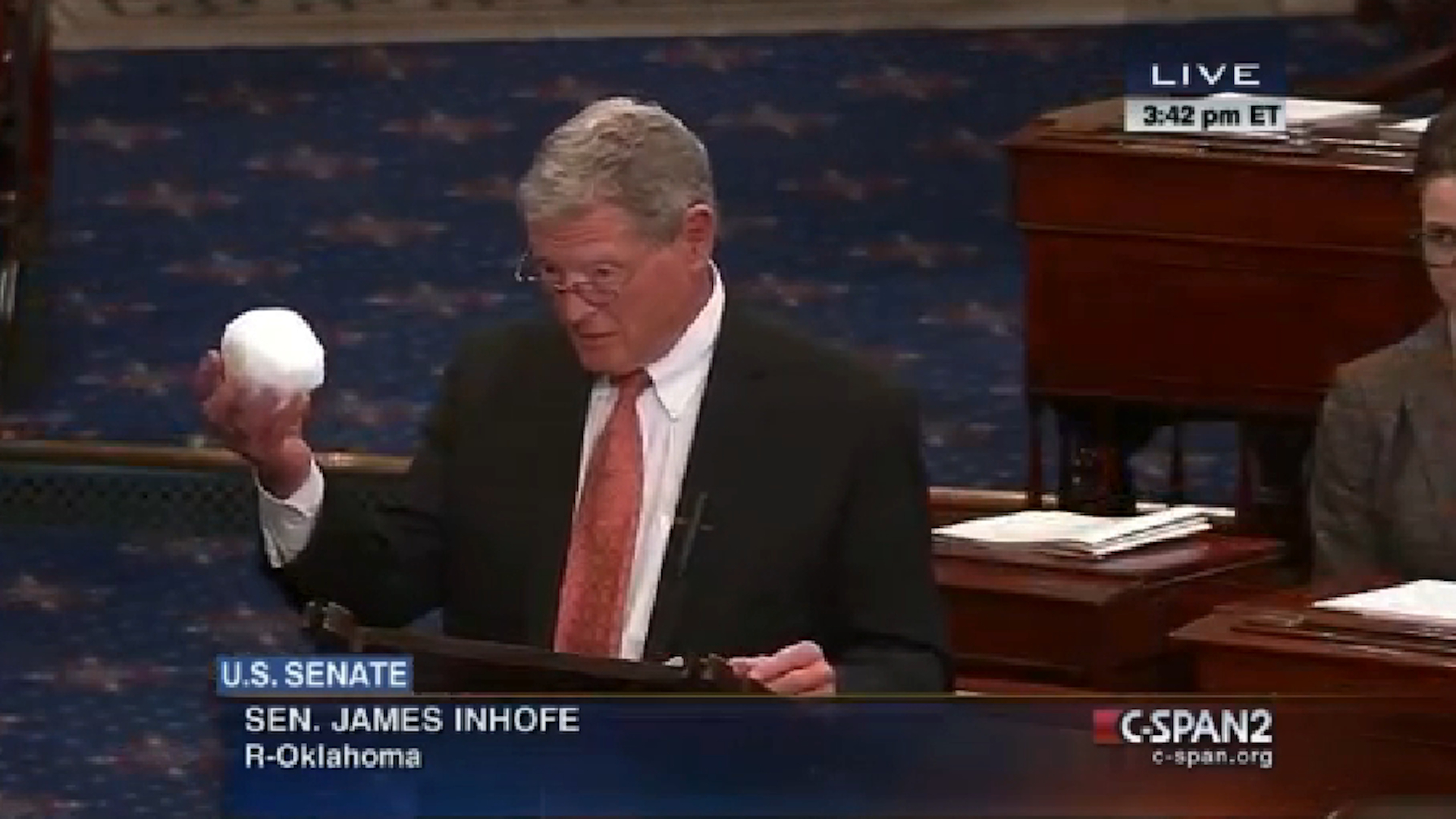
20150226_inhofe_snowballIn Miriam-Webster, belief is “a state or habit of mind in which trust or confidence is placed in some person or thing.” I’ve been mulling the grip of belief on public policy, prompted by reports of state legislators trying to block students from taking a certain history course because, they say, it emphasizes the wrong things.

Then came Jim Inhofe, the point man in Congress on environmental policy, who tossed a snowball on the Senate floor as evidence that global warming is a sham. In 2012 Inhofe published a book called The Greatest Hoax: How the Global Warming Conspiracy Threatens Your Future. Asking his reader why the book was necessary, the Oklahoma senator answers, “Very simple: the environmental activists extremists are not going away.”

Inhofe writes that his goal, from mayor of Tulsa to House member to senator, has been to “rein in the kinds of regulations that stifle entrepreneurship and job growth.” As a state legislator in 1967, he testified before the Senate committee he now chairs, Environment and Public Works, and decided he wanted to serve on it because it oversees EPA [established in 1970] – “an agency that puts forth some of the most job-destroying regulations in the country.”

“From farm dust to puddles of water on the road, there are very few aspects of American life that the Obama EPA is not planning to regulate. And it is businesses and working families who will pay the price.”

Devoutly religious, Inhofe quotes Genesis 8:22: “As long as the earth endures, seedtime and harvest, cold and heat, summer and winter, day and night will never cease.” In a radio interview, Inhofe explained his inclusion of the passage in the book. “My point is, God’s still up there. The arrogance of people to think that we, human beings, would be able to change what He is doing in the climate is to me outrageous.”

Early in the book, Inhofe explains his motive in running for mayor. He had gone to the city engineer’s office for a permit to move a fire escape on an abandoned historic building he had bought. In Inhofe’s telling, the city engineer rejected the proposal. “So I told him I was going to run for mayor and fire him. And I ran for mayor and fired him.”

Many people, particularly scientists, find a politician like Inhofe easy to scorn (though not dismiss – he holds power). He does not set out to discover but to confirm: that the Bible is literally true, that entrepreneurs are virtuous, that bureaucrats seek self-aggrandizement, that the U.N. Intergovernmental Panel on Climate Change is an agent of one-world government. I’m out to neither scorn nor dismiss, but to understand. After all, he has been elected over and over, in 2014 with 68 percent of 791,000 votes cast. He represents 3.9 million Oklahomans and a lot more elsewhere.

Inhofe’s hold on beliefs (if not the beliefs themselves) is not so different from the way most of us operate. We all have beliefs born of experience, and every day we employ them to make decisions, some in a split second, others with deliberation.

Joel Achenbach of The Washington Post wrote recently about why science is so hard to believe, from the safety of vaccines to the dangers of Ebola to the risks of GMO crops. This month, a government nutrition panel reversed a decades-long advisory against eating high-cholesterol foods, concluding that dietary cholesterol has nothing to do with the kind in our blood.

“The scientific method leads us to truths that are less than self-evident, often mind-blowing and sometimes hard to swallow,” Achenbach wrote. But our political divide, which is well outlined by the global warming debate, is not defined by whether we reject the scientific method. According to a study led by Dan Kahan at Yale, our division over climate change stems not from scientific illiteracy but because those who are literate understand the issue’s implications for their respective values.

Kahan and his colleagues found that people of a “hierarchical, individualistic” worldview, who tie authority to conspicuous social rankings and deplore collective interference with  individuals holding authority – basically contemporary Republicans – “tend to be skeptical of environmental risks” because they understand the implications: restrictions on commerce and industry. On the other hand, egalitarian/communitarians (Democrats) “tend to be morally suspicious of commerce and industry, to which they attribute social inequity.” Thus they accept – if not embrace – restrictions on industry that would accompany an acknowledgement of climate change.

That is to say, our political inclinations have us prewired for our view on global warming. Then, in the age of the Internet and narrowcast media, we seek information that confirms those inclinations.

Science, on the other hand, is constantly challenging itself, as the cholesterol advisory shows. Concludes Achenbach, “Scientists can be as dogmatic as anyone else – but their dogma is always wilting in the hot glare of new research.” For many who appear positioned on the science of climate change or the implications of high school history, the dogma is unshaken.

Posted in environment | Tagged , , , , , , | 2 Comments

American exceptionalism and the context of fear

Headlines roar over Rudy Giuliani’s latest personal shot against the president for being unpatriotic and an Oklahoma legislator’s bill to bar high school students from taking AP history. Both actions and reactions concern our image of America.

Giuliani gets attention whenever he tosses a rhetorical grenade. In his incarnation as a political personality (supported by a thriving consulting business), he is as provocative as a Rush Limbaugh, but as a former mayor and presidential candidate he has a certain, if dwindling, legitimacy.

Attempting to calibrate remarks in which he said Obama “doesn’t love America,” Guiliani wrote in The Wall Street Journal: “Irrespective of what a president may think or feel, his inability or disinclination to emphasize what is right with America can hamstring our success as a nation. This is particularly true when a president is seen, as President Obama is, as criticizing his country more than other presidents have done, regardless of their political affiliation.”

The key phrase is when a president is seen, as President Obama is. When who sees? Perhaps Giuliani knows – and perhaps he doesn’t – that the judgment about whether Obama criticizes his country, or does so more than other presidents, is his. Why not own it?

I ran across a crystalizing comment on the controversy on The New York Times website. “Jonathan” wrote, “The president is the leader of the USA. He is supposed to promote the glories of the American way of life, and tout the virtues of our system. We have enemies and college professors who can point out all the shortcomings.”

The swipe against professors brings us to Oklahoma, where Republican state Representative Dan Fisher said he would revise his bill, passed in committee on a party-line vote, to have the state replace the College Board’s Advanced Placement history course with a legislatively directed alternative. (AP tests, which universities nationwide acknowledge, enable students to obtain college credits.)

Barring funding for Oklahoma students to take the optional course, as Fisher proposed, would neither reduce students’ college costs nor improve their standing for admission. But the bill is consistent with a resolution the Republican National Committee approved in 2014, two years after the College Board rewrote its course guidance. The RNC condemned the 110-page “framework” as “a radically revisionist view of American history that emphasizes negative aspects . . . while omitting or minimizing positive aspects.” Policy disputes about the document have arisen in Texas, Georgia, South Carolina, a county in Colorado, and elsewhere.

What’s this about?

A struggle for national identity and narrative. It’s no accident that a controversy over “exceptionalism” is erupting in a political culture that has been polarized since the 2000 election. We have debated the meaning of 9/11, the “War on Terror” and its effects, the causes of and our responses to the Great Recession. We are divided not only on where to go but where we are. It’s not a fight from the 1990s, when we were riding high as the world’s superpower after the Soviet Union’s collapse. Then we were content to be exceptional. Now we argue over whether we – our president, our high school teachers – should promote the idea that we are.

According to the Pew Research Center, our sense of American exceptionalism has dropped sharply in recent years. Among survey respondents, the share that believes the U.S. is “exceptional” and stands above all other countries has dropped from 38 to 28 percent. Pew found in 2011 and 2014 that the belief in exceptionalism is much higher among Republicans than among Independents and Democrats, but it’s dropped by about the same proportions.

We are operating in a context of fear. People with whom we disagree aren’t merely wrong, they are unpatriotic. Not only are our adversaries stupid, they are evil.

It seems that, as our insecurity grows, our underlying beliefs become more entrenched. Rather than stepping back to check our assumptions, we hold tighter to being right.

It’s a belief. A belief is nothing more than a thought I continue to think. If you think it’s more than that, ask your neighbor what is true for him. Be prepared to listen.

Posted in education | Tagged , , , , | 4 Comments

‘American Sniper’ and the illusion of separation

Two scenes struck me in “American Sniper.” If you’ve been hiding under a rock or are otherwise unaware of the Oscars, the movie is a biopic based on the best-selling memoir of Chris Kyle, a Navy SEAL and Iraq War veteran who was killed two years ago by a troubled Marine vet whom Kyle was trying to help readjust to civilian life.

In the first scene, Kyle (Bradley Cooper) gets a call on his satellite phone from his wife Taya, who while walking out of her obstetrician’s office tells him their first baby will be a boy. Kyle is riding in a convoy in Iraq that comes under fire, and he drops the phone on the ground as he scrambles out of the truck. Taya is shown in medium shot that moves in, as she hears nothing over the phone but the gun battle. She is in meltdown, yelling into the phone, connected to the war but not to her husband. The camera pulls back, and behind Taya people go in an out of the office building. They either don’t notice a very pregnant woman in distress, or they choose not to.

In the second scene, about five years later, Kyle is at an auto repair shop with his son. He signs the work order, the camera at medium shot so we take in the clerk, the waiting room, other customers. Kyle offers his son a lesson about the mechanics of a gumball machine. In close-up, a man introduces himself and explains that Kyle had saved his life in Iraq. He bends down and tells the boy his dad is a hero, that he is alive and has a two-year-old daughter because of him. The man stands and salutes. Kyle is stiff and uncomfortable, unable to acknowledge the praise. Behind the man, two customers, slightly out of focus, read magazines. They either don’t notice an unusual conversation, or they choose not to.

I have no idea what director Clint Eastwood intended in the way he shot those scenes. My interpretation is that we are routinely unaware of what is happening in front of us. The reality is that we are connected, and in the case of “American Sniper,” to a war in which only a tiny fraction of us had direct experience.

The ripples of Kyle’s life and death will play out over a long time. Because of one war in Iraq, we are in another, labeled ISIS, that has metastasized across the Middle East and beyond. We are inextricably tied to each other, to events on the other side of the world, to fellow customers in a repair shop.

Posted in Uncategorized, War | Tagged , , , , , , | 1 Comment

Gerrymandering: Politics as situational ethics?

The state senator had an appointment out of town, and all his colleagues knew it. As soon as he left, the other political party, exploiting its temporary one-seat advantage, rushed to the floor a new legislative district map, though the state had adopted a compromise following the decennial census nine months before. The new map, the other party believed, would assure it a solid majority beyond the decade. The senate passed it, on party lines, in 30 minutes.

Situational ethics: Who’s right? Was there a wrong?

The_Gerry-Mander_Edit

The “Gerry-Mander” by Elkanah Tisdale (1771-1835), in the Boston Centennial, 1812

The story is real. The senator was Henry L. Marsh, a Democrat in Richmond. Marsh’s appointment was in Washington, at Barack Obama’s second inauguration. The Virginia Senate was split 20-20, and the previous April it had hashed out a Senate map with Republican Governor Bob McDonnell. The elected attorney general, Republican Ken Cuccinelli, set to back the new plan, was gearing up to run for governor. Amid the uproar, however, the House speaker, Republican William J. Howell, killed the proposal on a parliamentary maneuver. Said Howell, “I am committed to upholding the honor and traditions of both the office of speaker, the institution as a whole and the Commonwealth of Virginia.”

Gerrymandering also has a long tradition, but its increasingly aggressive use, thanks to computer-generated voter data, is distorting our elections, diminishing our representation, discouraging voting, and feeding legislative gridlock. It is an opportunity to jam the other side in this 50-50 political era – not the cause but rather an effect of growing intolerance of views and priorities with which we, any of us, disagree.

State legislatures are splitting cities, towns, even voting precincts to maximize party control. The state houses in Raleigh, Columbus, Harrisburg and Tallahassee contend for the title; Richmond also shows prowess for the increasingly purple Commonwealth of Virginia.

The Democrat won the past two presidential and four U.S. Senate elections in the Old Dominion. Democrats swept statewide posts (governor, lieutenant governor, attorney general) in 2013, breaking a 40-year streak in which the White House’s party lost the governor’s mansion the following year.

In the Virginia Senate, Republicans hold a 21-19 majority (after a 2014 special election in which Democrats lost a seat). That slender divide may be a fair representation of the whole state – it’s hard to say, since Virginia voters do not register by party. But in the House of Delegates, the GOP has a 67-32 majority (with one independent). The U.S. House delegation is Republican, 8-3. What’s going on here?

First, a trend. The New Deal Coalition, in which rural whites tended to be Democrats, is (literally) dead. In Virginia as in some other states, many of their children left for the cities; those that remain tend to vote Republican.

Second, the Great Sorting. Democratic majorities tend to be concentrated in cities and close-in suburbs; they are dark blue. Exurbs and rural areas tend to be pink, though on two-color maps they are red. It’s challenging to spread Democratic voters beyond geographically compact districts. But as legislators know, the same skill they have applied to splitting precincts could be applied to creating representative maps.

Thus the third factor: gerrymandering. Of course partisans want to win, and the Constitution imposes few limits on redistricting. But gerrymandering counters the spirit of the Framers, who sought to counter what Madison called, in Federalist No. 10, the “mortal disease” of faction:

“Complaints are everywhere heard . . . that the public good is disregarded in the conflicts of rival parties, and that measures are too often decided, not according to the rules of justice and the rights of the minor party, but by the superior force of an interested and overbearing majority.”

What does an “overbearing majority” look like? Virginia’s Senate caper. And its House of Delegates elections.

In 2013, 52 of the 100 House winners were either unopposed or had no major-party opponent; another 23 won with at least 60 percent of the vote. Thus voters in three-fourths of the districts had no real choice. And they get it: Voter turnout in state elections (which is easy to measure, as elections occur in odd-numbered years, opposite federal) has declined by half over the past 30 years.

An advisory ethics panel appointed by Democratic Governor Terry McAuliffe issued recommendations in December, among them a non-partisan commission created under a constitutional amendment to draw state and congressional districts. The ethics panel, chaired by former Democratic congressman Rick Boucher and former Republican lieutenant governor Bill Bolling (who was presiding when the GOP pulled its Senate maneuver), explained its reasoning:

When politicians choose who[m] they will represent, rather than being chosen by their constituents, that decision is based predominantly on personal political preservation and enhancing the number of districts represented by the party that controls the redistricting process. Gerrymandering is a self-evident conflict of interests, inherently undemocratic and a disservice to the communities and people of the Commonwealth.”

Speaker Howell dismissed the proposal. His House has declined to act on similar bills.

Virginia

Virginia’s 2012 congressional districts (U.S. Department of the Interior)

Meanwhile, the General Assembly’s 2012 map of the state’s congressional districts was found in violation of federal voting rights law. A federal district court determined that the map packed black voters into the Third District, reducing their influence in adjacent districts and diminishing minority representation overall. The Assembly was ordered to draw a new map this year.

The state House and Senate maps, with 100 and 40 districts, are hard to decipher. The U.S. House map, with 11 districts, is easy. What’s with the 5th, stretching its middle finger from North Carolina to Loudoun County, 175 miles north? Or the 10th, which runs from the toniest suburbs of Washington over several Appalachian ridges to West Virginia?

I whack on Virginia because I’ve resided in it for 50 years. Of course the GOP isn’t alone. Across the Potomac, the overwhelmingly Democratic legislature in Annapolis produced a near mirror of Virginia’s 10th in Maryland’s 6th District, in hopes of picking off an incumbent Republican in 2012. (After Democrats targeted 10-term Rep. Roscoe Bartlett, some sniped at House Minority Leader Nancy Pelosi for inviting the Republican to sit with her at the 2011 State of the Union Address.) The 6th, after the 2000 census, ran from West Virginia under the Pennsylvania border to the Susquehanna River. Ten years later, the Democrats sacrificed the competitive 1st District on the Eastern Shore, ensuring it would stay Republican, and drew the 6th deep into D.C.’s liberal suburbs. It worked. Maryland’s U.S. House delegation went from 6-2 Democratic to 7-1, at the expense of Democrats on the Eastern Shore and Republicans in the mountains.

Maryland 2002

Maryland’s 2002 congressional map. The 6th District is orange; the 1st is green. (Maryland Department of Planning)

Maryland 2012

The 2012 map: the 6th District is green; the 1st is purple.

In a polarized era, characterized by our disdain for those who think another way, gerrymandering is a weapon. Maryland’s voter registration is 68 percent Democratic – less than a U.S. House delegation of 6-2, much less than 7-1. (Despite party registration, Maryland elected a GOP governor in 2014 and 2002.) But the Virginia GOP’s lock on the state and federal lower houses distorts the commonwealth’s political complexion. It does not represent us. 

Voters elsewhere are fighting back. In some states, including California and Florida, they have passed ballot initiatives affecting redistricting. Some have created appointed commissions to draw districts (like that recommended in Virginia). In Arizona, voters in 2000 passed an initiative to amend the state constitution to vest the drawing of congressional districts in an Independent Redistricting Commission (IRC).

The IRC drew the map in 2001. But after its second round in 2012, the legislature struck back, suing in federal court that the commission usurped the legislature’s authority under Article I section 4 (the Elections Clause): “The Times, Places and Manner of holding Elections for Senators and Representatives, shall be prescribed in each State by the Legislature thereof.” The court upheld the commission: “In Arizona the lawmaking power plainly includes the power to enact laws through initiative, and thus the Elections Clause permits the establishment and use of the IRC.”

The Supreme Court accepted the legislature’s appeal on two questions: whether the Elections Clause and federal law permit Arizona to use a commission to map congressional districts, and whether the legislature has standing to bring the suit. Oral argument is scheduled for March 2.

According to the Brennan Center, the decision in Arizona Legislature v. Arizona Independent Redistricting Commission could invalidate congressional redistricting commissions in half a dozen states and also throw into doubt the tie-breaking procedures used in four states to resolve legislative deadlocks.

Let me get this straight. The Arizona legislature didn’t like the result of a ballot initiative, so it took its constituents to court. What do you think?

Posted in gerrymandering, James Madison, U.S. Constitution | Tagged , , , , , , , , , , , | Comments Off on Gerrymandering: Politics as situational ethics?